

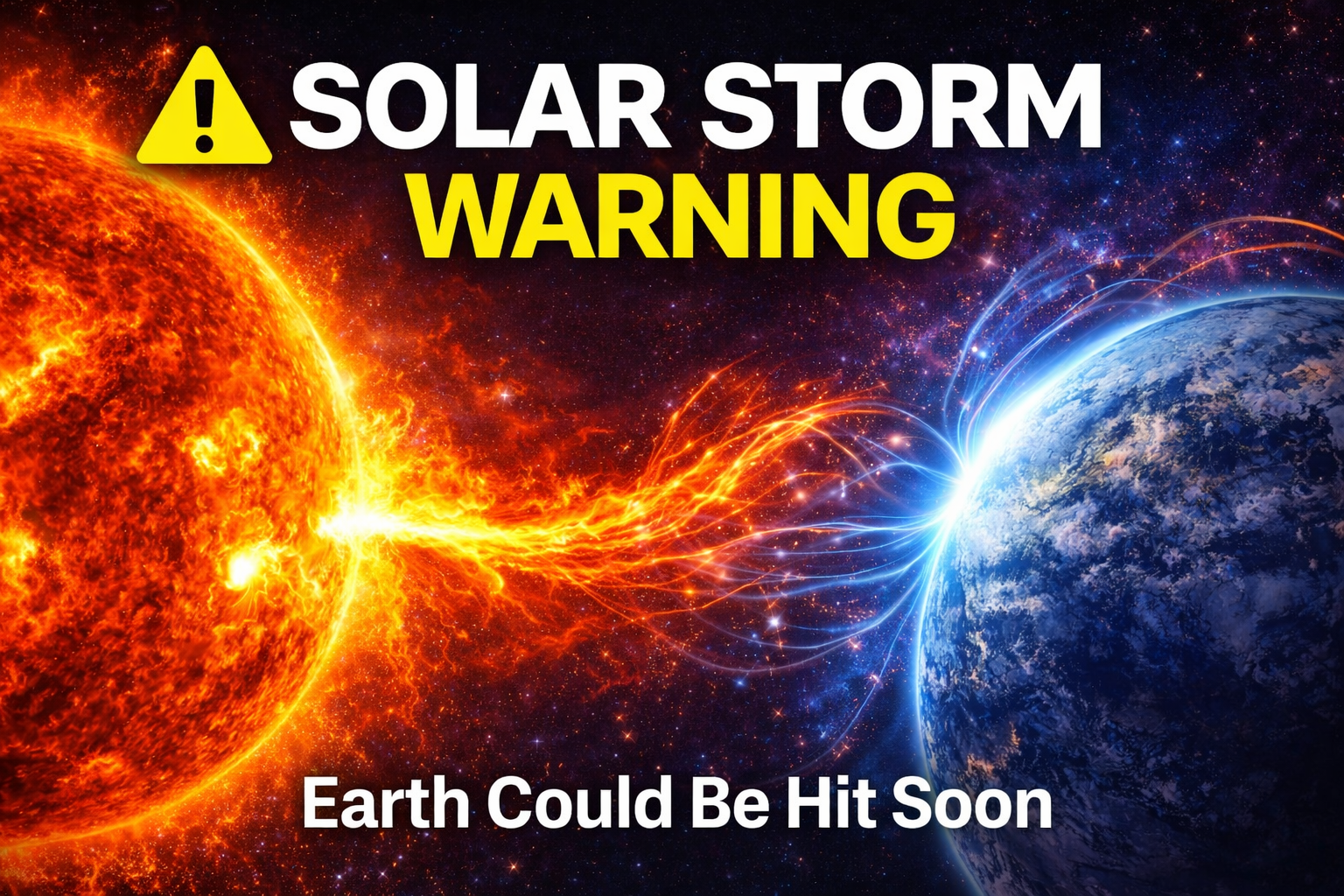
Scientists Warn Earth May Face an Extreme Solar Storm in 2026 – What It Could Mean for Technology
Scientists studying the activity of the Sun have issued warnings that the Earth could experience a powerful solar storm during the current solar cycle, raising concerns about possible disruptions to satellites, communication systems, and power grids.
Solar storms are not new, but experts say the increasing activity of the Sun means the coming years could bring some of the strongest space weather events in decades.
Researchers monitoring solar activity are now carefully tracking several large sunspots that have recently appeared on the surface of the Sun.
Understanding Solar Storms
A solar storm occurs when the Sun releases massive bursts of energy and charged particles into space. These eruptions often happen during solar flares or coronal mass ejections (CMEs).
When these charged particles travel toward Earth, they interact with the planet’s magnetic field. This interaction can produce beautiful natural light displays such as the auroras seen in polar regions.
However, in extreme cases, solar storms can also disrupt technology on Earth.
Organizations like NASA and the National Oceanic and Atmospheric Administration constantly monitor solar activity to predict potential space weather threats.
Why Scientists Are Concerned Now
The Sun follows an approximately 11-year solar cycle, during which its activity increases and decreases. During peak periods of the cycle, the number of sunspots, solar flares, and eruptions tends to rise dramatically.
Scientists believe the current solar cycle is approaching its most active phase, which means the likelihood of powerful solar storms is increasing.
Recent observations have revealed unusually large sunspot regions forming on the Sun’s surface. These areas are often responsible for producing strong solar flares.
Because of this, space weather researchers are closely monitoring whether any of these eruptions could be directed toward Earth.
How Solar Storms Could Affect Technology
Modern society depends heavily on technology, which makes strong solar storms a serious concern.
A powerful solar storm could potentially impact several critical systems, including:
- Communication satellites
- GPS navigation systems
- Airline communication networks
- Power transmission infrastructure
- Internet connectivity in some regions
When charged particles from the Sun interact with Earth’s magnetic field, they can generate electrical currents that interfere with sensitive electronic equipment.
Satellites orbiting Earth are particularly vulnerable because they operate outside much of the planet’s protective atmosphere.
Lessons From Past Solar Storms
One of the most famous solar storms in history occurred in 1859, known as the Carrington Event.
During that event, powerful solar eruptions caused telegraph systems across parts of Europe and North America to fail. Some telegraph lines even sparked fires due to electrical surges.
At the time, the world relied far less on technology than it does today. If a storm of similar strength occurred now, experts believe the effects could be much more significant.
Although events of that magnitude are rare, scientists say they are still possible.
Monitoring the Sun in Real Time
Space agencies around the world use satellites and advanced telescopes to observe the Sun continuously. These systems help scientists track solar flares and predict whether they might affect Earth.
Early warnings can allow satellite operators and power companies to take protective measures, reducing potential damage.
Researchers are also working on improving models that forecast space weather, much like meteorologists predict storms in Earth’s atmosphere.
Could Earth Experience a Major Solar Storm Soon?
Experts emphasize that predicting the exact timing of a major solar storm is extremely difficult. However, increased solar activity means the probability of strong space weather events is higher during peak phases of the solar cycle.
Scientists stress that warnings about solar storms are part of ongoing monitoring rather than a prediction of an immediate disaster.
Still, the possibility of an extreme event highlights the importance of preparing global technology systems for potential disruptions.
The Bright Side of Solar Storms
While strong solar storms can pose risks to technology, they also create spectacular natural phenomena.
When charged particles from the Sun interact with Earth’s magnetic field, they produce colorful light displays known as auroras.
These glowing lights, often called the Northern Lights and Southern Lights, can sometimes become visible much farther from the poles during intense solar storms.
For many people, these rare displays are among the most beautiful natural sights on Earth.
A Reminder of Our Connection to Space
Solar storms remind us that Earth is deeply connected to the activity of our nearest star. Although the Sun provides the energy that sustains life, it is also capable of producing powerful forces that affect our planet.
By studying space weather and improving prediction systems, scientists hope to protect modern technology while continuing to explore the mysteries of the universe.
As the current solar cycle reaches its peak, researchers will continue watching the Sun closely — ready to warn the world if a major solar storm begins heading toward Earth.