

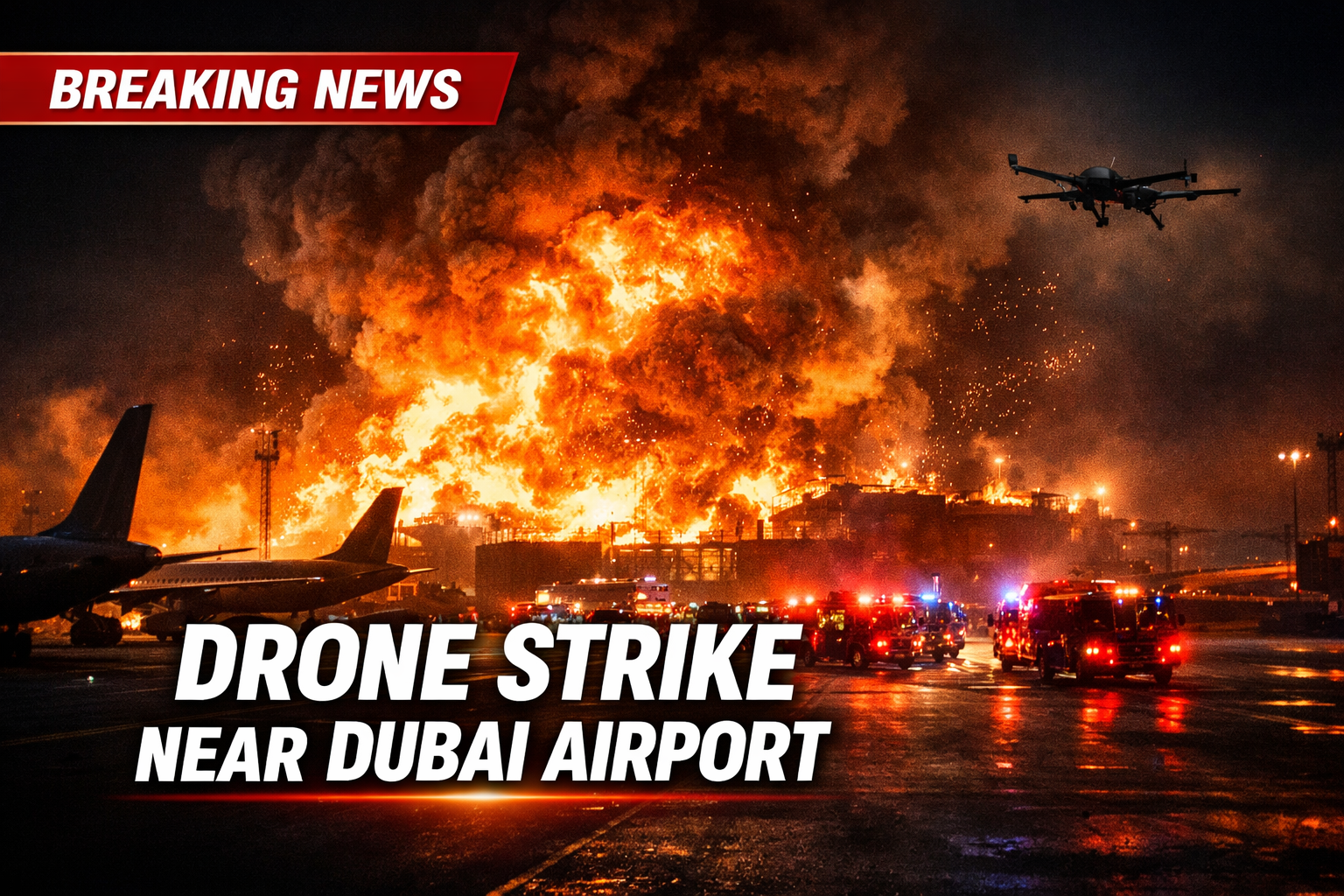
Middle East War Escalates: Drone Strike Near Dubai Airport Triggers Global Oil Panic
The Middle East crisis has entered a dangerous new phase after a dramatic drone strike near Dubai International Airport triggered massive fires and disrupted flight operations, raising fears of a wider regional war and sending shockwaves through global energy markets.
The shocking incident occurred early Monday when a fuel storage tank near the airport caught fire following what authorities described as a drone-related strike. Emergency crews rushed to control the blaze while aviation officials temporarily suspended flight operations in one of the world’s busiest travel hubs.
The attack comes amid rapidly escalating tensions between Iran, the United States, and Israel — a confrontation that analysts warn could spiral into a broader regional conflict with severe global consequences.
According to reports, a drone strike triggered a major fire near Dubai airport. Read Full report here <a href=”https://www.hindustantimes.com/world-news/drone-strike-sparks-huge-fire-near-dubai-airport-flights-suspended-traffic-routes-closed-10-updates-101773633032113.html” target=”_blank” rel=”noopener”>
Drone strike near Dubai airport triggers fire
</a>
Drone strike near Dubai airport triggers fire
This report explains that a drone attack caused a fuel tank fire near Dubai International Airport, forcing temporary flight disruptions.
A Dangerous Escalation in the Gulf
The Middle East has been on edge for weeks as military exchanges intensified between Iran and its rivals. The latest drone strike near Dubai signals that the conflict is now spreading beyond traditional battle zones.
Dubai, widely seen as one of the most secure and stable cities in the Gulf region, rarely experiences military-related incidents. The strike has therefore shocked both residents and international observers.
Security experts believe the attack may have been linked to the expanding confrontation involving Iran, the United States, and Israel. Recent reports indicate that multiple countries in the region have experienced missile launches, drone attacks, and retaliatory strikes.
The growing instability is raising concerns that the conflict could disrupt global shipping routes and energy supplies.
Strait of Hormuz Crisis Intensifies
At the heart of the global concern is the Strait of Hormuz — a narrow waterway through which roughly one-fifth of the world’s oil supply passes.
The United States has reportedly called on allied nations to help secure the vital shipping route after threats emerged that the strait could be blocked during the escalating conflict.
Any disruption to this strategic chokepoint could trigger a massive spike in global oil prices and lead to widespread economic turmoil.
Energy analysts warn that even temporary closures or attacks on oil infrastructure could send shockwaves across global markets.
To stabilize supplies, international energy agencies have already begun releasing emergency oil reserves to prevent shortages and calm financial markets.
Global Markets React With Fear
Financial markets around the world reacted immediately after reports of the Dubai strike began circulating.
Oil prices surged amid fears that supply disruptions could occur if the conflict spreads further across the Gulf.
Energy traders are closely monitoring developments near the Strait of Hormuz, where any military escalation could threaten the flow of millions of barrels of oil each day.
Major airlines are also reviewing flight routes across the region to avoid potential danger zones.
Some carriers have already rerouted flights away from sensitive areas as a precaution.
Military Tensions Continue to Rise
The wider regional conflict has intensified dramatically in recent weeks.
Reports suggest that coordinated strikes targeting Iranian military infrastructure sparked retaliatory attacks across the region. Missile launches, drone strikes, and air raids have been reported in multiple countries.
Security analysts describe the situation as one of the most volatile geopolitical crises in recent years.
Several governments have warned their citizens traveling in the Middle East to remain alert as tensions continue to escalate.
Military forces across the region have also increased readiness levels amid fears of further attacks.
US Strikes Iran’s Kharg Island: Rising Middle East Tensions Shock Global Oil Markets
Airlines and Travel Industry on Alert
Dubai International Airport is one of the world’s busiest aviation hubs, handling millions of passengers each month.
The temporary suspension of flight operations following the fire disrupted numerous international routes and caused delays for travelers worldwide.
Although authorities moved quickly to contain the situation, aviation experts say the incident highlights the vulnerability of major infrastructure in conflict zones.
Airlines may now reconsider routes that pass through the Gulf region if security risks continue to increase.
Travel companies are also monitoring the situation closely as tourism across the Middle East could be affected by prolonged instability.
Global Leaders Call for Calm
World leaders have urged restraint as tensions threaten to escalate further.
Diplomatic channels are reportedly working behind the scenes to prevent the conflict from spreading across the region.
However, with military operations already underway and retaliatory strikes continuing, many experts believe the crisis could deepen before any resolution is reached.
International organizations have also warned that the humanitarian and economic consequences of a broader regional war could be severe.
Why This Crisis Matters to the World
While the conflict may appear regional, its impact could be global.
The Middle East plays a crucial role in supplying energy to the world economy.
If the Strait of Hormuz were blocked or major oil facilities were damaged, the resulting energy shock could affect fuel prices, transportation costs, and inflation worldwide.
Countries across Asia and Europe rely heavily on oil shipped through the Gulf, meaning even limited disruptions could ripple through the global economy.
This is why governments and financial institutions are closely watching every development in the region.
What Could Happen Next?
Experts believe several scenarios could unfold in the coming weeks.
The best-case scenario involves diplomatic intervention and de-escalation between the countries involved.
However, if retaliatory attacks continue, the conflict could expand across multiple Middle Eastern nations.
Military analysts warn that cyberattacks, drone strikes, and naval confrontations could become more frequent as the crisis evolves.
For now, the world is watching closely as one of the most sensitive geopolitical flashpoints moves toward an uncertain future.
Conclusion
The drone strike near Dubai International Airport marks a dramatic escalation in the already volatile Middle East crisis.
With military tensions rising and energy markets on edge, the incident has highlighted how quickly regional conflicts can threaten global stability.
As governments scramble to prevent further escalation, the world waits to see whether diplomacy or conflict will shape the next chapter of this unfolding crisis.
One thing is clear — the situation remains extremely fragile, and the coming days could prove decisive for the region and the global economy.