

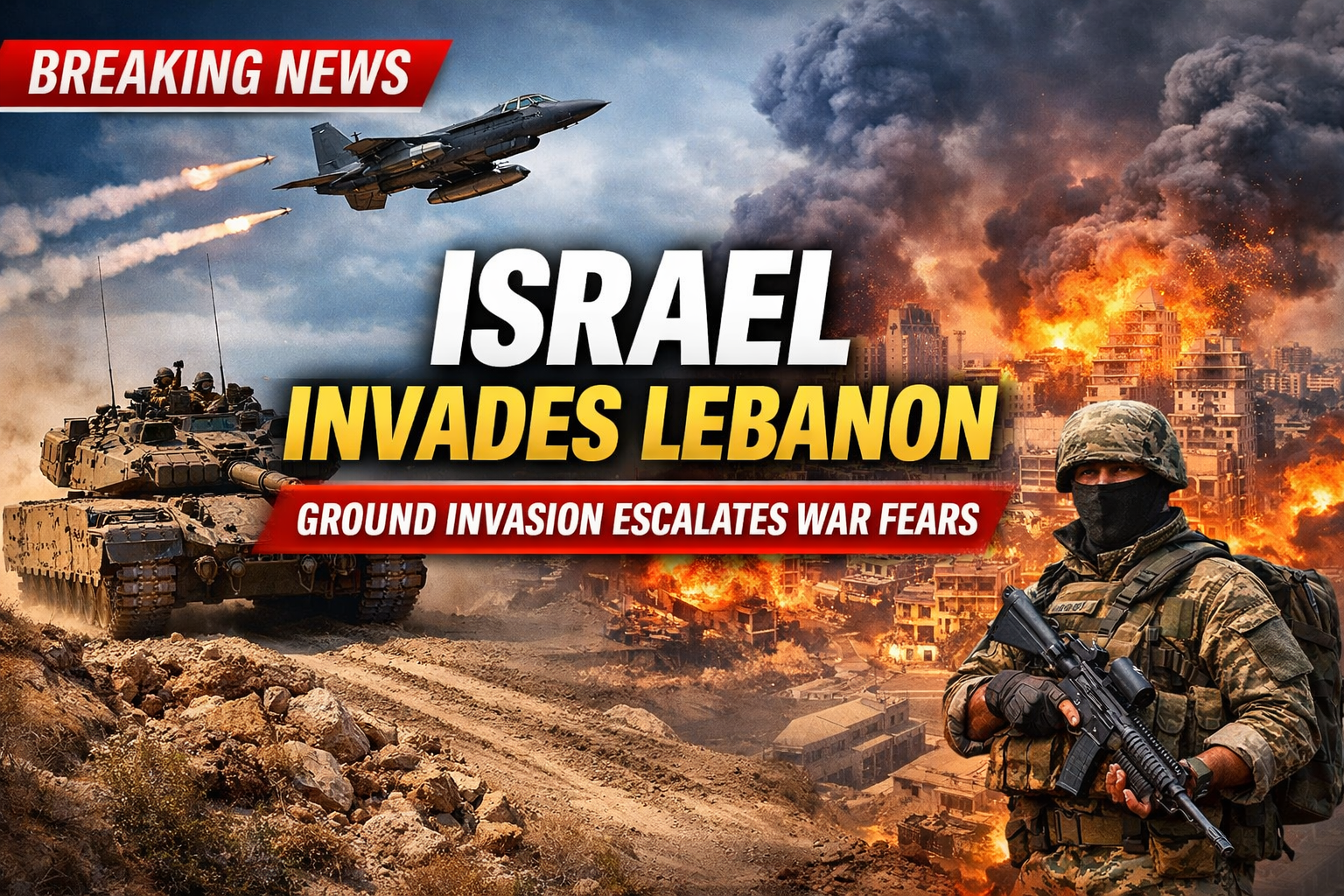
🚨 Israel Launches Ground Invasion Into Lebanon, Triggering Major Escalation
In a significant and alarming development, Israel has launched a large-scale ground invasion into southern Lebanon, marking a major turning point in the ongoing conflict in the Middle East. The move comes after days of escalating tensions, including airstrikes, cross-border fire, and rising hostilities between armed groups along the border.
Military units crossed into Lebanese territory under heavy aerial support, targeting what officials describe as strategic militant positions. The operation signals a shift from limited engagements to a broader and more direct confrontation, raising concerns across the international community.
The situation remains fluid, with continuous reports of explosions, troop movements, and military activity emerging from the region.
Middle East War Escalates: Drone Strike Near Dubai Airport Triggers Global Oil Panic
⚔️ Rapid Escalation Changes the Nature of the Conflict
What began as localized tensions has now transformed into a wider military operation. The ground invasion indicates a significant escalation in both strategy and scale.
In recent days, there had already been signs of intensifying conflict. Airstrikes increased in frequency, and both sides exchanged fire across the border. The buildup of troops and military equipment suggested that a larger operation was imminent.
Now, with ground forces actively operating inside Lebanese territory, the conflict has entered a new and more dangerous phase. This shift increases the risk of prolonged fighting and broader regional involvement.
🌍 Rising Global Concern Over Expanding Conflict
The escalation has drawn immediate attention from governments and international organizations around the world. Many leaders have expressed concern about the potential consequences of a prolonged conflict.
Emergency discussions are taking place among global powers, with calls for restraint and diplomatic solutions growing louder. However, the complexity of the situation makes immediate resolution difficult.
The involvement of multiple actors in the region adds another layer of uncertainty. Analysts warn that if the conflict continues to expand, it could draw in additional groups or nations, further destabilizing the region.
⚠️ Humanitarian Situation Worsens
As military operations intensify, the humanitarian situation is becoming increasingly critical. Civilians living in border regions are facing growing risks as violence spreads.
Thousands of families have already begun fleeing their homes, seeking safety in less affected areas. Reports indicate that displacement numbers are rising quickly, with shelters and emergency services struggling to keep up.
Basic infrastructure, including roads, electricity, and communication systems, has been affected in several areas. Access to essential supplies such as food, water, and medical care is becoming more difficult for those caught in the conflict.
Aid organizations are calling for safe corridors to allow civilians to evacuate and for humanitarian assistance to reach those in need.
🔥 Continuous Military Activity Across the Border
The ground invasion is being supported by ongoing air and artillery operations. Military aircraft continue to carry out strikes on targeted locations, while artillery units provide support from across the border.
Explosions have been reported in multiple areas, with smoke visible from several towns and villages. The intensity of the operations suggests that this is not a limited incursion but part of a broader military campaign.
Both sides remain on high alert, and the situation on the ground is evolving rapidly. The risk of further escalation remains high as military actions continue.
🌐 Diplomatic Efforts Struggle to Keep Pace
While military activity intensifies, diplomatic efforts are also underway to prevent further escalation. International organizations and mediators are working to open channels of communication between the involved parties.
However, progress has been slow. The fast-moving nature of the conflict, combined with deep-rooted tensions, has made negotiations challenging.
Several countries have urged immediate de-escalation and a return to dialogue, emphasizing the importance of avoiding a wider regional crisis. Despite these calls, the situation on the ground continues to deteriorate.
🧠 Uncertainty Over What Comes Next
One of the most concerning aspects of the current situation is the uncertainty surrounding its outcome. With ground forces now involved, the conflict could take multiple paths.
Possible scenarios include prolonged fighting, increased regional involvement, or eventual diplomatic intervention. Each outcome carries its own risks and consequences.
Experts caution that once a conflict reaches this level of escalation, it becomes much harder to control. The coming days will be crucial in determining whether tensions can be contained or if the situation will worsen further.
📱 Global Attention Intensifies
As news of the invasion spreads, global attention has sharply increased. People around the world are closely following updates, with constant demand for real-time information.
Images and videos from the region are circulating widely, highlighting the intensity of the situation and the impact on civilians. The speed at which information is being shared reflects the level of global concern.
The story continues to dominate headlines, with new developments emerging frequently.
⚡ Conclusion
Israel’s ground invasion into southern Lebanon marks a critical turning point in the ongoing conflict. What was once a localized issue has now evolved into a broader and more dangerous situation with potential global implications.
The combination of military escalation, humanitarian concerns, and international tension makes this one of the most significant breaking news stories at the moment.
As events continue to unfold, the world watches closely, hoping for de-escalation while preparing for the possibility of further developments.