

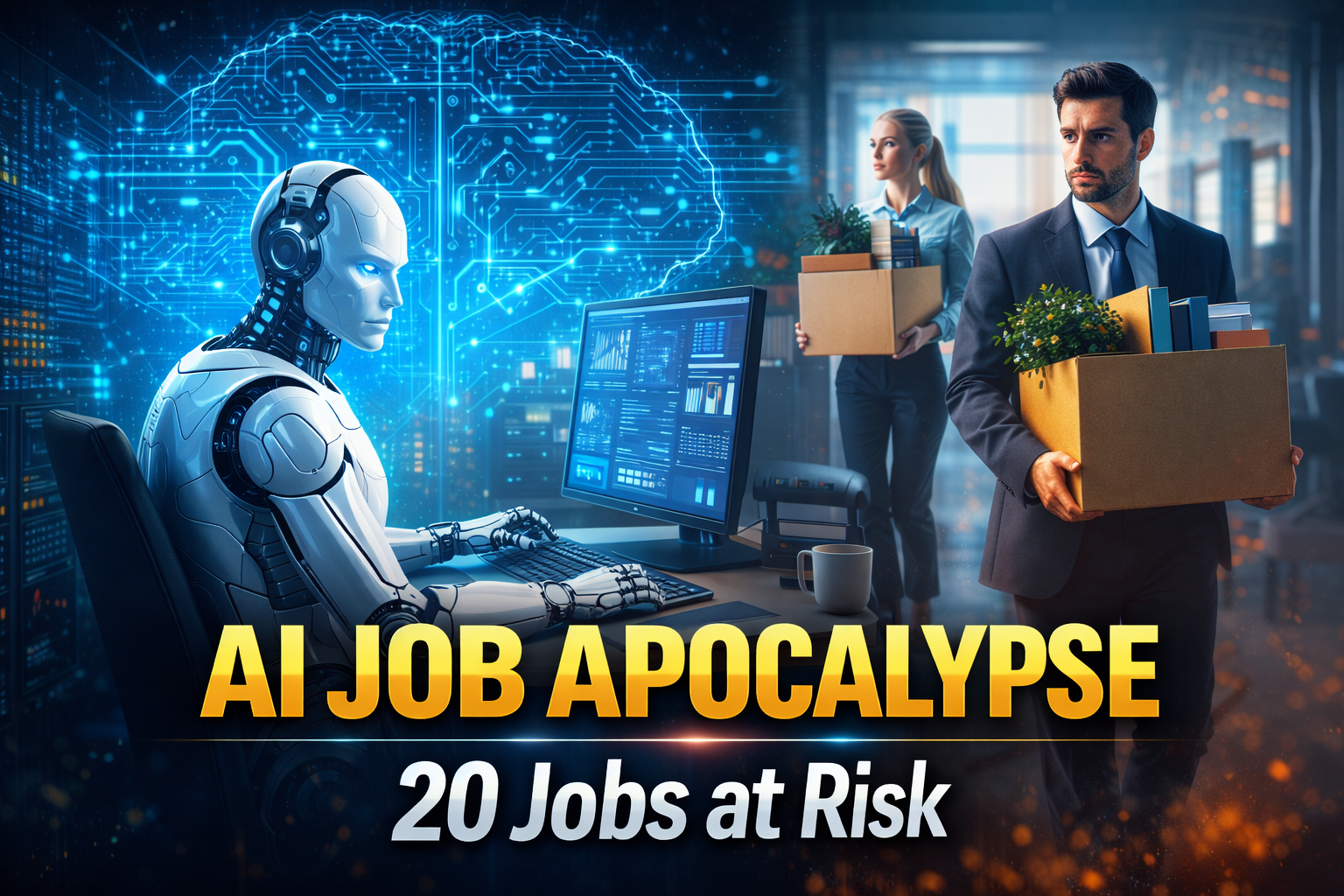
AI Job Apocalypse 2026: These 20 Professions Could Disappear in the Next 5 Years
Artificial intelligence is rapidly changing how the world works. From automated customer service to AI-powered content creation, technology is beginning to perform tasks that were once handled entirely by humans. While this transformation is creating exciting opportunities, it is also raising serious concerns about the future of employment.
Experts are now warning about what some analysts call an “AI job apocalypse.” The term refers to the possibility that millions of workers could see their roles reduced or replaced by intelligent automation in the coming years. As AI systems become more advanced and affordable, companies are increasingly adopting them to improve efficiency and reduce operational costs.
The question many people are now asking is simple but important: which jobs are most at risk?
Why Artificial Intelligence Is Advancing So Quickly
The rapid growth of AI technology is largely driven by breakthroughs in machine learning and large language models. These systems are capable of analyzing vast amounts of information, recognizing patterns, and generating responses that resemble human communication.
Organizations like OpenAI and technology giants such as Google and Microsoft have invested billions of dollars into developing advanced AI platforms.
These tools can now write reports, generate images, answer questions, translate languages, and even assist with complex research tasks. Because AI can operate continuously without fatigue, many businesses see automation as an attractive alternative for routine tasks.
As a result, companies around the world are experimenting with ways to integrate AI into their operations.
Jobs That Could Disappear First
While artificial intelligence will not replace every profession, some roles are more vulnerable than others. Jobs that involve repetitive tasks, structured data, or predictable workflows are generally the easiest to automate.
Here are several professions experts believe could face significant disruption over the next five years.
1. Data Entry Clerks
Data entry is one of the most automation-friendly tasks. AI software can process and organize information far faster than humans.
2. Customer Service Representatives
Many companies are already using AI chatbots to handle customer inquiries. These systems can answer common questions instantly and operate 24 hours a day.
3. Telemarketers
Automated calling systems and AI marketing tools are gradually replacing traditional telemarketing roles.
4. Basic Content Writers
AI writing tools can generate articles, product descriptions, and social media posts in seconds.
5. Translators for Simple Text
Machine translation systems have improved dramatically in recent years, making basic translation work easier for AI.
6. Bookkeeping Assistants
Financial software powered by AI can automatically organize invoices, receipts, and financial records.
7. Retail Cashiers
Self-checkout technology and automated payment systems are reducing the need for traditional cashier roles.
8. Travel Agents
Online booking platforms and AI recommendation engines are simplifying travel planning.
9. Warehouse Pickers
Robotic automation is rapidly transforming logistics and warehouse management.
10. Basic Graphic Designers
AI image generation tools are beginning to handle simple design tasks.
These are only a few examples. Analysts estimate that many other jobs could experience significant transformation as artificial intelligence becomes more capable.
The Industries Most Affected
Several sectors are particularly vulnerable to automation.
Customer Service
Many companies are replacing traditional support centers with AI chat systems capable of handling thousands of conversations simultaneously.
Media and Content Creation
AI tools can generate written content, produce images, and assist with video editing.
Finance and Accounting
Advanced algorithms can analyze financial data, detect fraud, and automate routine accounting tasks.
Retail and E-Commerce
Automation is transforming inventory management, logistics, and checkout systems.
Transportation
Self-driving technology is gradually being developed to handle delivery and transportation services.
While complete automation may take years, these industries are already experiencing significant technological changes.
Not All Jobs Are at Risk
Despite the alarming headlines, experts emphasize that artificial intelligence will not eliminate all jobs. Instead, many roles will evolve rather than disappear completely.
Professions that require creativity, emotional intelligence, and complex problem-solving are much harder to automate.
Examples include:
- Healthcare professionals
- Psychologists and therapists
- Teachers and educators
- Engineers and scientists
- Creative artists and designers
These careers rely heavily on human interaction, empathy, and innovative thinking—qualities that AI still struggles to replicate.
New Jobs Are Being Created
While automation may reduce demand for certain roles, it is also creating entirely new opportunities. The rise of AI technology has already generated demand for specialists in fields such as machine learning engineering, AI ethics, and data science.
Companies need skilled professionals who can design, monitor, and improve AI systems. As a result, workers who develop digital skills may benefit from new career paths emerging in the technology sector.
For example, businesses using platforms developed by companies like NVIDIA and IBM often require experts capable of managing complex AI infrastructure.
This means the future workforce may shift toward more technical and creative roles.
Preparing for the Future of Work
As artificial intelligence continues to evolve, many experts recommend that workers begin adapting to the changing job market. Learning new skills and staying informed about technological developments can help individuals remain competitive.
Some valuable skills for the future include:
- Data analysis
- Digital marketing
- Programming and software development
- Creative problem solving
- Leadership and communication
Online learning platforms and training programs are making it easier for people to develop these abilities.
Education systems are also beginning to adjust their curricula to prepare students for an increasingly automated world.
The Debate Around AI and Employment
The rise of artificial intelligence has sparked an ongoing debate among economists, policymakers, and technology leaders. Some experts believe automation will lead to massive unemployment, while others argue that technology historically creates more jobs than it destroys.
During past technological revolutions, new industries eventually emerged to replace outdated ones. For example, the rise of the internet created millions of jobs that did not exist just a few decades ago.
Supporters of AI believe a similar transformation could happen again, with innovation generating entirely new economic opportunities.
However, the transition may not be smooth for everyone. Workers in vulnerable industries may need support through retraining programs and educational initiatives.
The Future Is Still Uncertain
Artificial intelligence is advancing faster than many people expected. Each year brings new breakthroughs that expand the capabilities of automated systems. While it is impossible to predict exactly how the job market will evolve, one thing is clear: technology will continue to reshape the global workforce.
For businesses, AI offers powerful tools to increase productivity and reduce costs. For workers, it represents both a challenge and an opportunity to adapt to new forms of employment.
The coming decade will likely determine whether artificial intelligence becomes a tool that enhances human potential—or a disruptive force that transforms the world of work forever.