

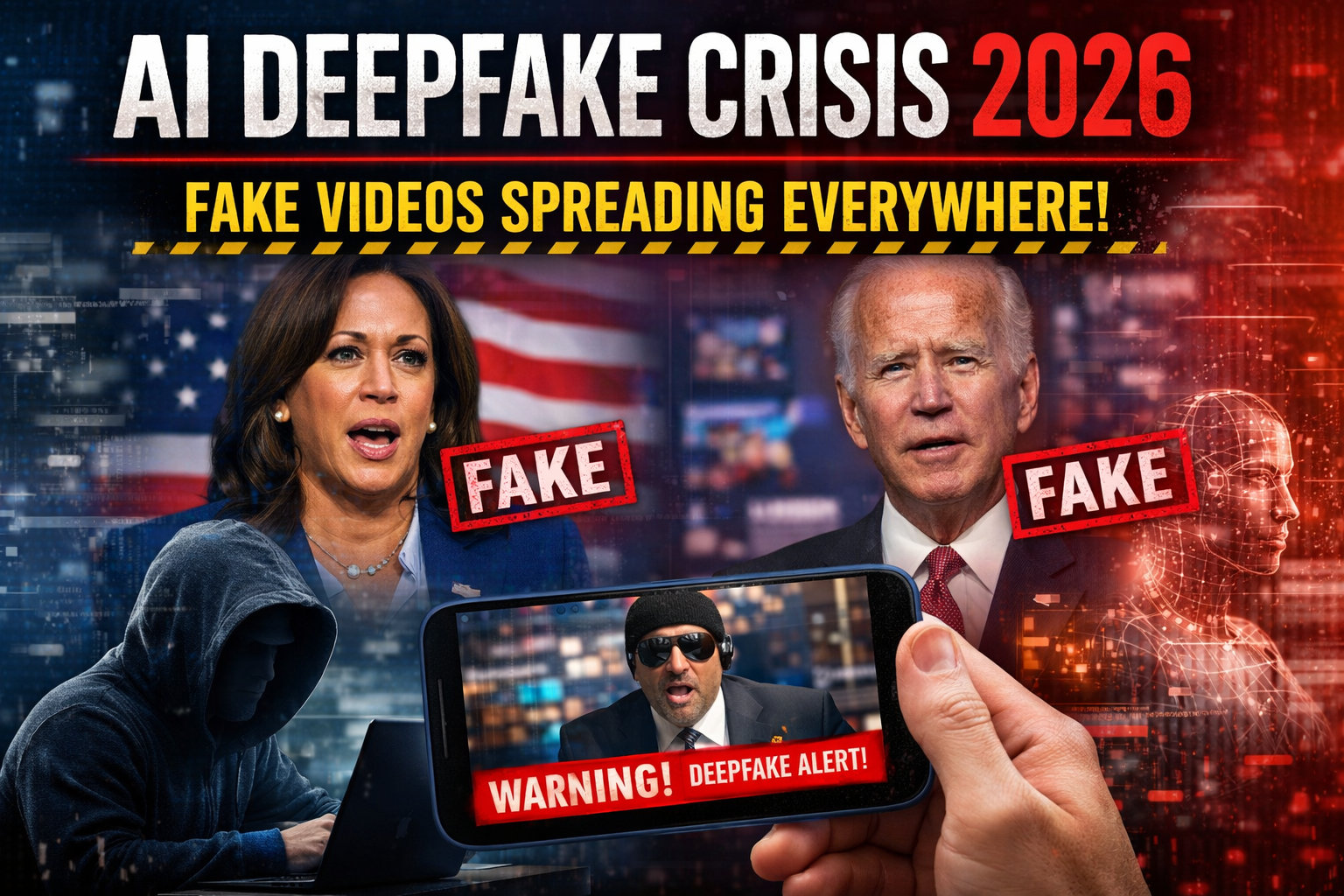
AI Deepfake Crisis 2026: Fake Videos Are Spreading Faster Than Truth
The internet has always been a place where information travels fast. But in 2026, something far more dangerous is happening—videos that look completely real are being created by artificial intelligence, even though they never actually happened.
This growing problem is known as the AI deepfake crisis, and experts believe it could become one of the most serious digital challenges of our time.
Across social media platforms, manipulated videos are appearing that show celebrities, politicians, and public figures saying things they never said. Many viewers believe these videos instantly, sharing them with friends and followers before realizing they may be fake.
As artificial intelligence becomes more powerful, the line between reality and digital manipulation is becoming harder to recognize.
A Technology That Can Rewrite Reality
Deepfake technology works by using advanced AI algorithms that study thousands of images and recordings of a person. The system learns how that person speaks, moves, and expresses emotions.
Once trained, the AI can generate new video or audio content that appears incredibly realistic.
This means a computer can produce a video of someone giving a speech they never gave or reacting to events that never happened.
Just a few years ago, this technology was mostly used by researchers or movie studios. But today, many AI tools capable of generating deepfake content are available online.
Because these tools are becoming easier to access, more people are experimenting with them—sometimes responsibly, but sometimes with harmful intentions.
Why Experts Are Sounding the Alarm
Technology specialists and cybersecurity analysts are increasingly concerned about the rapid growth of deepfake videos.
One reason for the concern is how quickly misinformation spreads online. When a shocking video appears on social media, users often react emotionally. They share the content without checking whether it is authentic.
Within minutes, a manipulated video can reach thousands or even millions of viewers.
Even if fact-checkers later prove the video is fake, the damage may already have been done.
According to technology researchers and reporting from organizations like Reuters and BBC News, deepfake technology is becoming one of the biggest emerging challenges in the fight against online misinformation.
Social Media Is Fueling the Spread
Modern social media platforms are designed to promote engaging content. Videos that generate strong emotional reactions—shock, anger, or excitement—are more likely to go viral.
That makes deepfake videos particularly dangerous.
Platforms such as YouTube, Instagram, and X (Twitter) can rapidly distribute viral clips across millions of users.
If a deepfake video appears dramatic or controversial, it may gain traction before anyone realizes it has been manipulated.
Experts warn that this environment creates a perfect storm where misinformation spreads faster than corrections.
Deepfake Scams Are Already Happening
Beyond misinformation, deepfake technology is also being used for financial fraud.
Cybercriminals have started experimenting with AI-generated voices that sound almost identical to real individuals. In some cases, scammers impersonate business leaders and send voice messages instructing employees to transfer money.
Believing the message comes from their boss, victims sometimes follow the instructions—only to discover later that the voice was artificially generated.
This new type of scam highlights how deepfake technology could transform cybercrime.
Businesses around the world are now investing heavily in cybersecurity systems designed to detect suspicious activity and protect against AI-driven impersonation.
Governments Are Starting to Take Action
As deepfake incidents become more common, governments are beginning to examine how the technology should be regulated.
Lawmakers in many countries are discussing policies that would require social media companies to remove harmful AI-generated content quickly.
Some proposals also focus on holding creators of malicious deepfake videos legally responsible for the damage they cause.
However, regulating deepfakes is not easy. The internet allows digital content to spread across borders instantly, making it difficult for any single country to control the problem alone.
Because of this, experts believe international cooperation will be necessary to develop effective solutions.
Technology Companies Are Fighting Back
While deepfake technology creates risks, artificial intelligence is also being used to combat the problem.
Researchers are developing detection systems that analyze videos for subtle signs of manipulation. These tools examine facial movements, lighting patterns, and digital artifacts that may reveal AI editing.
Another promising approach involves digital watermarking. AI-generated content could include hidden signals indicating that it was created by artificial intelligence.
If widely adopted, these markers could help viewers quickly identify manipulated media.
However, experts caution that the race between deepfake creators and detection systems is ongoing. As AI becomes more sophisticated, identifying fake content will likely become more challenging.
What Internet Users Can Do
While governments and technology companies work on solutions, internet users also play an important role in preventing misinformation from spreading.
Experts recommend being cautious when encountering sensational or controversial videos online.
Before sharing content, it is wise to check whether reputable news sources have reported the same information. Looking for original sources, official statements, or fact-checking articles can help determine whether a video is genuine.
In the digital age, critical thinking is becoming one of the most important skills for navigating online information.
The Future of Truth in the Digital Age
The rise of deepfake technology raises a difficult question: How will people trust what they see online in the future?
For many years, videos and photographs were considered reliable forms of evidence. But as artificial intelligence becomes capable of creating extremely realistic media, that assumption is beginning to change.
Experts believe society is entering a new phase where verifying digital information will become essential.
The challenge ahead will be balancing the incredible potential of artificial intelligence with the need to protect truth and trust on the internet.
If governments, technology companies, and users work together, the digital world may still find ways to adapt.
But one thing is certain: the AI deepfake crisis is only beginning, and its impact on the internet could shape the future of information for years to come.