

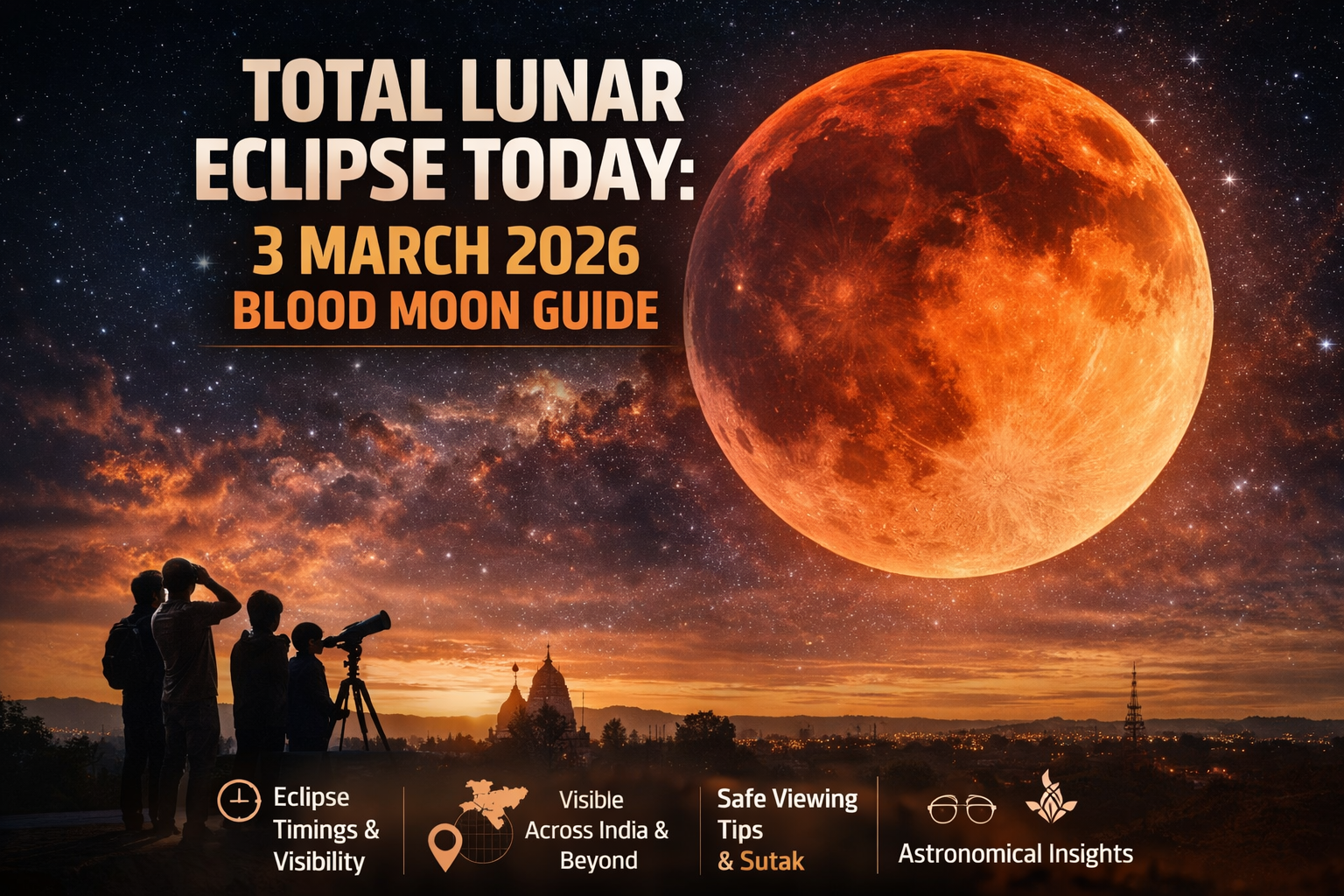
🌗 Total Lunar Eclipse Today: 3 March 2026 Blood Moon Guide
On Tuesday, 3 March 2026, skywatchers across the globe will witness a spectacular Total Lunar Eclipse — often called a “Blood Moon” because the Moon turns a deep reddish-copper hue as it passes into Earth’s shadow. This astronomical event is rarely aligned with global festivals and has captured worldwide attention, especially since it coincides with the festival of Holi in India.
A lunar eclipse occurs when the Earth moves directly between the Sun and the Moon, casting its shadow on the Moon’s surface. Unlike solar eclipses, total lunar eclipses are safe to view with the naked eye — no eye protection is needed.
📅 When & How the Eclipse Happens
The eclipse began as Earth’s penumbral shadow started grazing the Moon, and the full eclipse (when the Moon enters the umbra, or darkest part of the shadow) unfolds in phases. For many viewers around the world, the timeline on 3 March 2026 looks like:
- Penumbral phase begins: early shading starts before full eclipse
- Partial eclipse begins: Moon progressively darkens as it enters Earth’s core shadow
- Totality (Blood Moon): the Moon glows red as it is fully in Earth’s shadow
- Eclipse ends: gradual return to full lunar brightness as Moon exits shadow
Totality lasts around ~58 minutes, giving observers nearly an hour to enjoy the remarkable “Blood Moon” effect before the Moon returns to its usual appearance.
🌍 Global Visibility: Where You Can See It
The Total Lunar Eclipse on 3 March 2026 is visible from multiple continents, but the time and clarity vary depending on your location:
🌎
Asia and Australia
Most of Asia and Australia will see at least parts of the eclipse. In India, the Moon will rise already in eclipse, allowing viewers in the eastern states and islands to catch more of the display before it ends at moonset.
🌍
North America & Pacific Region
Observers in the western half of North America and Pacific regions can witness the totality phase as the Moon climbs higher in the sky — a perfect opportunity for early morning telescopic and naked-eye viewing.
🌏
Parts of Africa and South America
Eclipse visibility is partial due to moonrise and moonset timings, but enthusiasts may catch glimpses of the penumbral or partial phases if skies are clear.
🕒
Indian Timings & Sutak Period
In India, astronomical and cultural observances are blending together:
- Sutak period starts early morning — a traditional timeframe when certain rituals are avoided (as per Hindu beliefs).
- The visible portion of the eclipse occurs as the Moon rises over eastern India, typically in the late afternoon and early evening.
- Based on local timings, the eclipse continues until about 6:46 PM IST, when the Earth’s shadow clears the Moon.
Many skywatchers will get a window of roughly 15–30 minutes to enjoy the phenomenon in parts of India — particularly in eastern and northeastern states where moonrise coincides with the eclipse’s peak.
🌕 Why It’s Called a Blood Moon
During totality, Earth’s atmosphere bends sunlight into the shadow, filtering out blue wavelengths and leaving red light to gently illuminate the Moon’s surface. This creates the distinctive blood-red appearance, making it one of the most striking sky events of the year.
This eclipse also stands out because it’s the last total lunar eclipse visible globally until late 2028, making 2026’s Blood Moon a rare and memorable celestial spectacle.
🧭 Best Viewing Tips
✔️ Find a clear, open sky — away from city lights for optimal viewing
✔️ No protective eyewear needed — safe with the naked eye
✔️ Use binoculars or telescopes for enhanced depth and detail
✔️ Check local timings — the Moon rises at different times depending on location
📌 Final Thoughts
The Total Lunar Eclipse on 3 March 2026 offers an unmatched blend of science, culture, and natural beauty. Whether it’s called the “Blood Moon” for its dramatic red hue, or simply a lunar eclipse for its astronomical significance, this event beckons millions of people worldwide to look skyward and connect with the wonders of our universe.
- Let this be the featured astronomical story on your blog today — because total lunar eclipses like this don’t come around again for years. 🌕