

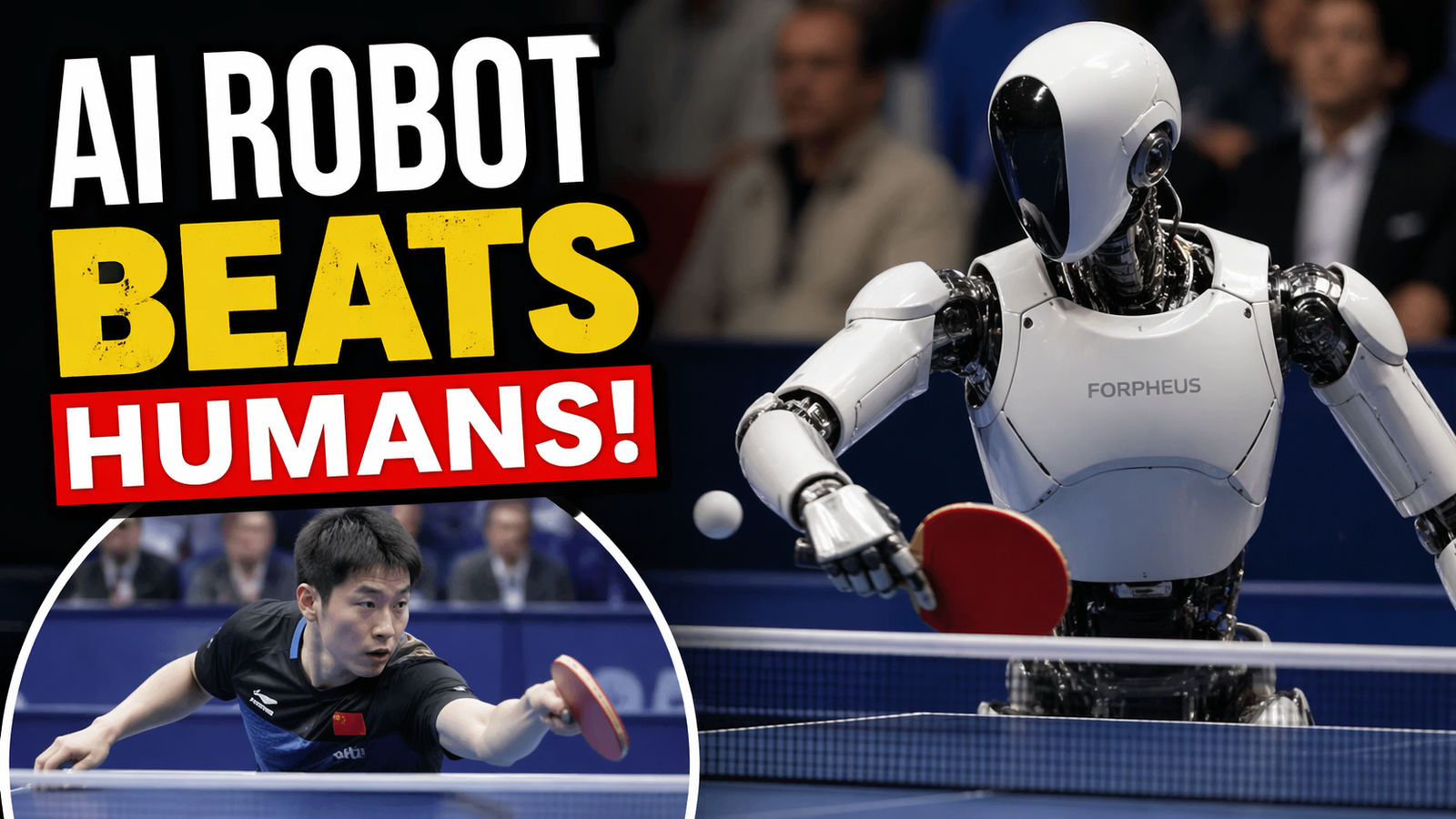
AI Robot Beats Human Players in Ping Pong — And People Can’t Stop Watching
There’s something strangely fascinating about watching a machine do something deeply human.
That’s exactly why a new AI-powered ping pong robot is getting attention around the world. In recent demonstrations, the robot showed speed, timing, and reaction skills strong enough to challenge — and in some cases outperform — experienced human players.
At first glance, it might seem like a fun tech stunt. A robot with a paddle? Cool, sure.
But honestly, this moment feels bigger than table tennis.
Because when machines start mastering fast, unpredictable human activities like sports, it signals something important: artificial intelligence is moving beyond screens and into the physical world faster than many people expected.
And yes, people are paying attention.
What Happened?
Researchers and engineers have been developing robotic systems that can play table tennis for years. But recent progress has taken things to another level.
This latest robot combines several advanced technologies at once:
- High-speed cameras that track the ball in real time
- AI systems that predict movement
- Robotic arms capable of rapid, precise motion
- Continuous learning models that improve through play
That combination allows the machine to react within fractions of a second — often faster than a human can consciously process.
Ping pong might look simple, but it’s actually one of the toughest environments for robotics. The ball moves quickly, changes spin constantly, and can bounce unpredictably.
So when a machine performs well here, experts notice.
Let’s be real: if a robot can handle ping pong, it can probably handle a lot more than ping pong.
Why This Matters Right Now
AI stories usually focus on chatbots, image generators, or software tools. But this development points to the next phase of the AI race: machines that understand and interact with the real world.
That changes the conversation.
Instead of asking whether AI can write emails or generate photos, people are now asking:
- Can robots replace skilled labor?
- Can AI assist athletes or coaches?
- Can machines train faster than humans?
- What jobs become easier — or disappear entirely?
Those questions feel less theoretical today.
Physical AI is becoming real, and sports is one of the clearest ways for the public to see it happening.
That’s why this story is trending beyond tech circles. It’s visual, surprising, and a little unsettling.
Why Ping Pong Is a Big Deal in Robotics
Here’s the thing most people miss: table tennis is incredibly difficult for machines.
To succeed, the robot must:
Read the ball’s speed instantly.
Estimate spin.
Predict bounce angle.
Move the paddle with exact timing.
Adjust after every shot.
Learn from the opponent’s patterns.
Humans do much of this instinctively. We don’t calculate angles consciously — our brains adapt in motion.
For a robot, every one of those steps is hard.
That’s why table tennis has become a kind of benchmark challenge in robotics, similar to how chess once became a benchmark for computer intelligence.
Years ago, beating humans at chess felt shocking. Then it became normal.
Now we may be watching the sports version of that shift begin.
Real-World Impact on Everyday People
You might not care who wins a ping pong match between a person and a robot. Fair enough.
But the technology behind it could affect everyday life in ways that matter much more.
1. Smarter Home Robots
Machines that can react quickly and safely in changing environments may one day help with chores, elderly care, or home assistance.
2. Better Physical Therapy
Robotic systems with precise motion control could help patients recover movement after injuries or surgeries.
3. Sports Training Tools
Athletes may use AI-powered machines that adapt to their weaknesses in real time, creating smarter practice sessions.
4. Industrial Safety
Factories already use robots, but future systems could become more flexible, responsive, and safer around human workers.
So while this story looks playful on the surface, the applications are serious.
Why People Online Are So Interested
Some tech stories feel abstract. This one doesn’t.
You can watch it.
That matters.
A robot writing code isn’t visually dramatic to most people. A robot returning lightning-fast shots against a human? That’s instantly understandable.
It also taps into a classic human emotion: curiosity mixed with competition.
We naturally wonder:
Can it beat a beginner?
Can it beat a champion?
Would I score a point against it?
That emotional hook is exactly why stories like this spread fast on social media and Google Discover.
They combine technology with human stakes.
Is This the Start of AI in Sports?
In many ways, it already started.
AI is now used in:
- Match analytics
- Injury prediction
- Player tracking
- Personalized training plans
- Strategy simulation
- Referee assistance systems
The robot ping pong moment simply makes the invisible visible.
Instead of software quietly analyzing numbers in the background, people can now see intelligence in motion.
And that changes how the public responds.
Truth is, seeing a machine move like that hits differently.
What Could Happen Next?
We’re likely to see three major trends.
Human + AI Training Partnerships
Rather than replacing players, robots may become advanced training partners who never tire and adapt instantly.
More Public Showdowns
Expect more events where robots challenge humans in games, sports, or skill contests. These attract huge attention.
Everyday Consumer Robotics
As hardware gets cheaper and AI gets smarter, some of these technologies may enter homes, gyms, and schools.
That said, widespread household robotics still faces hurdles: cost, safety, battery life, and reliability.
So no, robot roommates probably aren’t arriving tomorrow.
But the path is clearer than it was a few years ago.
The Bigger Emotional Question
Every time machines improve, people ask the same quiet question:
Where does that leave us?
It’s understandable.
When AI writes, paints, drives, and now competes physically, some people feel inspired. Others feel anxious.
Both reactions are valid.
But maybe the better question isn’t whether machines can outperform humans in narrow tasks.
Maybe it’s what humans still uniquely bring: creativity, empathy, judgment, meaning, humor, resilience.
A robot can return a serve.
It still can’t understand why winning matters to you.
That distinction may matter more than ever.
Should We Be Worried?
Not immediately.
This robot isn’t about replacing all athletes or taking over sports. It’s a research showcase and a glimpse of future capability.
Still, developments like this remind us that AI progress doesn’t stop at software.
It expands.
And society will need smart conversations about how these tools are used, who benefits, and where limits should exist.
That conversation is only beginning.
Final Thoughts
A robot beating humans at ping pong sounds like a novelty headline.
But underneath it is a serious story about where technology is headed.
Machines are getting faster, smarter, and more physically capable. What once looked futuristic now feels surprisingly normal.
And honestly, that may be the most important signal of all.
Because the future rarely arrives with dramatic music.
Sometimes it arrives holding a paddle.
FAQ
Did the AI robot really beat human players?
Yes, advanced table tennis robots have demonstrated the ability to compete strongly against skilled human players in controlled settings. Performance depends on level, environment, and match conditions.
Why is ping pong important for AI research?
Ping pong requires rapid reactions, motion prediction, precision movement, and adaptation — making it an ideal test for robotics and real-world AI.
Will robots replace human athletes?
Highly unlikely. Sports are about entertainment, emotion, identity, and human competition. Robots are more likely to become training tools than replacements.
Could this technology help regular people?
Yes. Similar systems may improve rehabilitation, home assistance, industrial safety, and sports coaching.
Is this why the story is trending?
Exactly. It mixes AI, competition, surprise, and visual excitement — all ingredients that capture attention quickly.