

🔥 Intro
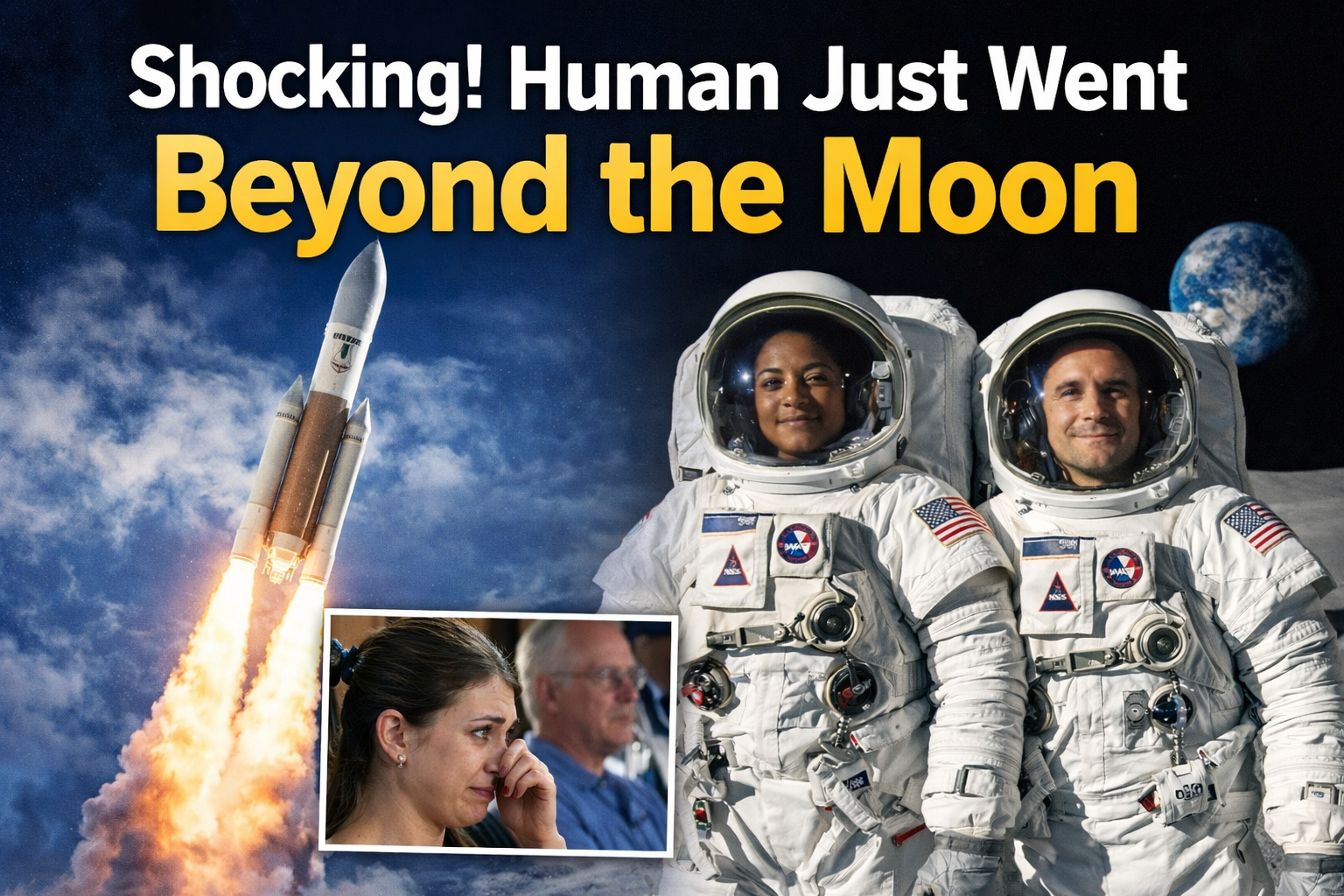
For the first time in over 50 years… humans didn’t just visit the Moon — they went beyond it.
Yeah, read that again.
While most of us were scrolling Instagram or watching reels, something insane was happening above our heads. A spacecraft carrying real humans traveled deeper into space than anyone has in generations — and safely came back.
This isn’t just another space update.
This is the moment that could quietly change the future of humanity.
NASA Sends Rocket to the Moon Today: Artemis Mission Begins a New Era of Space Exploration
🌕 What Actually Happened?
The mission is called NASA’s Artemis II — and it’s not just hype.
This crewed mission flew astronauts around the Moon, but here’s the crazy part:
👉 They didn’t just orbit close like before
👉 They went thousands of kilometers beyond the Moon
👉 Then returned to Earth at insane speed
At one point, the spacecraft hit speeds of nearly 40,000 km/h during re-entry. That’s not just fast — that’s unimaginably fast.
And the heat?
Around 2,700°C.
That’s hotter than lava.
🧠 Why This Feels Like a Big Deal (Because It Is)
Let’s be real — people stopped getting excited about space missions after the Apollo era.
But this one hits differently.
Here’s why:
1. It’s Been 50+ Years
The last time humans went this far was during the Apollo missions in the 1960s–70s.
This isn’t routine.
This is history repeating itself… but at a much bigger scale.
2. This Is Not About the Moon Anymore
The Moon is just a step.
The real target?
👉 Mars
👉 Deep space exploration
👉 Possibly human settlements in the future
This mission basically tested:
- Can humans survive longer deep-space travel?
- Can spacecraft handle extreme re-entry?
- Are we ready for longer missions?
Short answer:
We’re getting very close.
🌍 What This Means for Regular People
You might be thinking:
“Okay cool… but how does this affect me?”
Fair question.
Here’s the real impact 👇
🚀 Technology Will Trickledown
Space missions always lead to real-world tech:
- Better GPS systems
- Advanced materials
- Medical innovations
- AI & robotics improvements
What starts in space ends up in your phone, your car, even hospitals.
📱 Future Jobs & Opportunities
This isn’t just science — it’s a whole new economy.
- Space tourism
- Private space companies
- Satellite industries
Gen Z today could literally work in space-related careers tomorrow.
🌌 A Shift in Human Mindset
This matters more than people realize.
Moments like this remind humanity:
👉 We’re not stuck on Earth forever
👉 There’s more out there
👉 Progress is still happening
And honestly… in a world full of negative news, this feels refreshing.
👨🚀 What the Astronauts Experienced
Imagine this:
You’re looking at Earth… not as a country, not as borders…
But as one small blue planet floating in darkness.
That’s what astronauts described.
Silence.
Isolation.
And something they call the “overview effect” — a mental shift where everything on Earth suddenly feels connected.
Not gonna lie… that hits deep.
🏛️ What Happens Next?
This mission is just the beginning.
Here’s what’s coming next:
👉 Artemis III
- Planned Moon landing again
- Possibly include the first woman on the Moon
👉 Lunar Base Plans
- Scientists are already planning permanent Moon stations
👉 Mars Missions
- The ultimate goal
- Likely in the next couple of decades
Basically… this mission opened the door.
📊 Real Talk: Is This Actually Safe?
Space is still dangerous. No sugarcoating that.
But missions like this prove:
- Technology is improving fast
- Safety systems are stronger
- Human endurance is better understood
We’re not 100% there yet… but we’re not far either.
🌌 The Part No One Is Talking About…
Here’s something most headlines aren’t really focusing on…
This mission wasn’t just about going far.
It was about proving that humans can handle being away from Earth longer than ever before.
And that’s a psychological challenge, not just a technical one.
Out there, it’s not like orbiting Earth where you still feel “close.”
Once you go beyond the Moon… Earth starts shrinking. Fast.
It becomes this tiny blue dot.
And that does something to your brain.
Astronauts have described moments where:
- Time feels slower
- Silence feels louder
- And the idea of “home” hits differently
That’s the kind of experience no simulator on Earth can truly replicate.
🧪 The Science Happening Behind the Scenes
While everyone is focused on the visuals and the speed… there’s a whole layer of science quietly running in the background.
This mission tested:
- Radiation exposure levels (deep space is way more dangerous than Earth orbit)
- Human body reactions in longer missions
- Navigation systems far away from Earth signals
- Life support systems under extreme conditions
And here’s the interesting part…
Deep space radiation is one of the biggest problems for Mars missions.
So if this mission successfully handled even part of that challenge, it’s a massive step forward.
Because right now, one of the biggest fears is:
👉 “Can humans survive a months-long journey to Mars without serious health risks?”
This mission is helping answer that.
🛰️ Private Space Race Is Quietly Heating Up
Another thing most people are missing…
This isn’t just about **NASA anymore.
Behind the scenes, private companies are watching very closely.
Because once missions like this succeed:
- Investment in space startups increases
- Billionaires double down on space tech
- New partnerships start forming
Companies like:
- Space tourism startups
- Satellite internet providers
- Aerospace tech firms
…are all waiting for moments like this.
Because success here = opportunity everywhere.
You might not see it immediately, but this mission could trigger a whole wave of:
👉 New funding
👉 New jobs
👉 New innovations
And suddenly, space stops being “just science” and becomes a full-on industry.
🌍 Why This Moment Feels Different From Before
Let’s be honest…
We’ve seen space news before. Rockets launch all the time.
So why does this one feel bigger?
Because of timing.
Right now, the world is in a weird place:
- Economic uncertainty
- Tech disruption
- People constantly glued to screens
And in the middle of all that…
This mission reminds people of something bigger than daily chaos.
It pulls attention away from short-term noise and puts it on long-term human progress.
That emotional shift?
That’s powerful.
It’s the kind of story people don’t just read… they feel.
📡 The Communication Challenge Most People Don’t Realize
Here’s another underrated detail…
Communication in deep space is not instant.
When the spacecraft moves farther away:
- Signals take longer to travel
- Real-time communication becomes harder
- Decision-making shifts more to astronauts themselves
At certain distances, even a simple message can take several seconds (or more) to reach Earth.
That might not sound like much…
But in space, seconds matter.
This mission tested how well crews can operate with:
👉 Delayed instructions
👉 Limited real-time support
👉 More independence
And that’s exactly what future Mars missions will require.
Because on Mars missions, delays could be minutes, not seconds.
🔥 The Re-Entry Moment That Had Everyone Holding Their Breath
If there was one moment that really made scientists nervous…
It was the return.
Coming back to Earth from deep space is not like returning from low orbit.
It’s faster.
Hotter.
Riskier.
The spacecraft basically slammed into Earth’s atmosphere at extreme speed, creating temperatures hot enough to melt most materials.
Everything depended on:
- Heat shield performance
- Angle of entry
- Structural integrity
One small error… and things could go very wrong.
That’s why this part of the mission wasn’t just technical — it was emotional.
Because after traveling so far… everything comes down to those final minutes.
And when it worked?
That’s when people knew — this mission wasn’t just successful…
It was a turning point.
❓ FAQ Section
Q1: Why is Artemis II so important?
Because it’s the first deep-space human mission in over 50 years and prepares for future Moon and Mars missions.
Q2: Did the astronauts land on the Moon?
No, this mission was a flyby to test systems. Landing will happen in future missions.
Q3: How fast was the spacecraft?
Around 40,000 km/h during return to Earth.
Q4: Is this connected to Mars missions?
Yes. This mission is a stepping stone toward sending humans to Mars.
Q5: When is the next mission?
Artemis III is expected in the coming years, aiming for a Moon landing.
🧠 Final Thoughts
It’s kind of crazy when you think about it.
We’re living in a time where:
- AI is evolving fast
- Technology is exploding
- And now… humans are pushing deeper into space again
This mission didn’t just go beyond the Moon.
It reminded us that we’re still exploring… still building… still moving forward.
And maybe — just maybe — the future we used to imagine in movies isn’t that far away anymore.