

🧠 Intro
AI co-worker — yeah, it sounds a bit weird at first.
Like something you’d only hear in a tech podcast or some futuristic documentary.
But here’s the uncomfortable truth…
It’s already happening.
Right now, in 2026, AI is not just a tool you open and use anymore. It’s slowly turning into something much bigger — something that’s starting to work alongside you.
And no, this isn’t about robots taking over jobs overnight.
That’s the part most people get wrong.
What’s actually happening is more subtle… and honestly, more powerful.
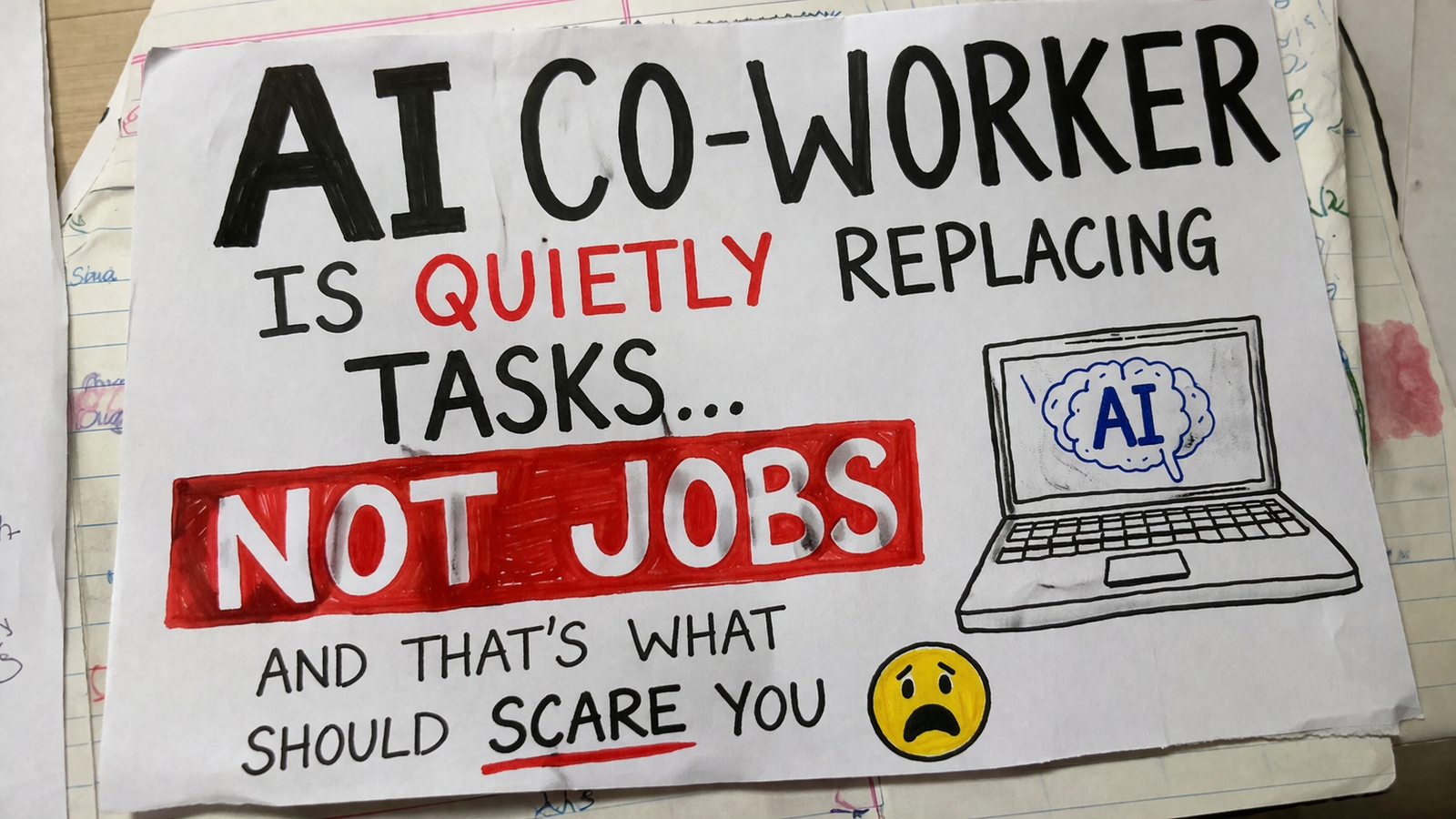
AI is replacing tasks, not entire jobs.
Which means:
- The boring, repetitive parts of your work? Gone.
- The time-consuming tasks? Automated.
- The “I’ll do it later” work? Already done by AI.
Sounds helpful, right?
AI Video Generator 2026: The Shocking Technology Creating Viral Videos in Seconds
It is.
But at the same time… it’s changing how humans fit into the system.
Because when AI starts handling 50–70% of the work, your role automatically shifts.
You’re no longer just “doing the job.”
You’re:
- Managing
- Reviewing
- Deciding
And that shift?
That’s where everything begins to change.
Let’s be honest for a second…
Most of us still think of AI as something you use.
Like — you open it, ask something, get an answer, close it.
Done.
But that idea?
Yeah… it’s already outdated.
Because right now, quietly, without making too much noise, AI is shifting from being a tool to becoming something way more serious:
👉 A co-worker.
Not in the “future someday” sense.
Not in sci-fi movie style.
It’s already starting.
And most people haven’t even noticed yet.
🤖 So What Does “AI Co-Worker” Even Mean?
This is where things get interesting.
Earlier:
- You wrote emails
- You made reports
- You scheduled meetings
Now?
AI is starting to do all of that on its own.
We’re talking about AI agents that can:
- Manage your calendar
- Write full reports without supervision
- Analyze data and make suggestions
- Handle customer support conversations
- Even coordinate between teams
And the crazy part?
👉 You don’t need to constantly guide it anymore.
It’s not just responding…
It’s acting.
⚙️ Why This Shift Is Happening Now
This didn’t just randomly happen.
A few things came together at the same time:
1. AI Got Smarter (Way Smarter)
Companies like OpenAI, Google, and Microsoft have pushed AI to a point where it can:
- Understand context
- Remember tasks
- Make basic decisions
That’s the foundation of a “worker.”
2. Businesses Want Speed (And Less Cost)
Let’s be real — companies are always looking for:
- Faster output
- Lower cost
- Less human error
AI gives all three.
So instead of hiring 3 people for repetitive tasks…
one AI system can handle a big chunk of that workload.
3. Automation Is No Longer Optional
Earlier, automation was like a “nice to have.”
Now?
It’s becoming survival.
Companies that don’t adopt AI risk falling behind — fast.
😳 What This Means for Real People
Okay… this is the part everyone is thinking about but not saying loudly.
👉 “Is AI taking jobs?”
The honest answer?
Not exactly. But also… kind of yes.
🧑💻 Jobs That Might Change First
- Data entry
- Basic content writing
- Customer support
- Scheduling/admin roles
These aren’t disappearing overnight.
But they are evolving.
Meaning:
👉 Less manual work
👉 More oversight + creative thinking
🚀 Jobs That Might Grow
At the same time, new roles are opening up:
- AI operators
- Prompt engineers
- AI workflow managers
- Tech + business hybrid roles
Basically, people who can work with AI, not compete against it.
📊 A Simple Real-Life Scenario
Imagine this.
Before:
You spend 4–5 hours writing reports, replying to emails, organizing tasks.
Now:
AI does 70% of that.
You just:
- Review
- Edit
- Approve
Your role shifts from “doing everything” → to “managing output.”
That’s a big change.
🧠 The Psychological Shift (This Is Important)
This change isn’t just technical.
It’s mental.
Because people are used to thinking:
👉 “I do the work.”
Now it’s becoming:
👉 “I supervise the work.”
And that can feel uncomfortable at first.
🏢 What Companies Are Already Doing
Some companies are already:
✔ Replacing repetitive roles with AI tools
✔ Training employees to work with AI
✔ Building internal AI systems for daily tasks
This isn’t experimental anymore.
It’s operational.
⚠️ But Let’s Not Overhype It
Here’s the grounded truth:
AI is powerful… but not perfect.
It still:
- Makes mistakes
- Lacks deep human judgment
- Needs supervision
So no — it’s not replacing everyone tomorrow.
But yes — it is changing how work happens.
🔮 What Happens Next?
This is where things get serious.
In the next 1–3 years, you’ll likely see:
- AI assistants becoming standard in jobs
- Teams shrinking but becoming more efficient
- More “human + AI collaboration” roles
- Faster work cycles
Basically… work itself will feel different.
🔍 One More Thing Nobody Is Talking About (But You Should)
There’s something subtle happening right now… and most people are missing it.
It’s not just that AI is becoming a co-worker.
👉 It’s that the definition of “productivity” itself is changing.
Earlier, being productive meant:
- Working more hours
- Doing more tasks
- Staying busy all day
Now?
It’s slowly shifting to:
- Getting results faster
- Managing smarter systems
- Knowing what to do, not just doing everything yourself
That’s a huge shift.
⚡ The Rise of “1-Person Powerhouses”
You’re going to start seeing something very interesting in the next few years.
People building:
- Full businesses
- Content platforms
- Online services
…with very small teams or sometimes even alone.
Why?
Because AI handles:
- Writing drafts
- Designing ideas
- Customer replies
- Data analysis
So one person, with the right tools, can now do what used to require a team of 5–10 people.
That changes competition completely.
🧠 But Here’s the Catch (Important)
More power doesn’t always mean more success.
Because now:
👉 Everyone has access to the same tools
Which means the real difference will come down to:
- Creativity
- Decision-making
- Consistency
- Personal thinking
AI can generate options…
But it can’t fully replace your judgment.
🚀 A Simple Reality Check
If you ignore AI — you fall behind.
If you depend on AI completely — you lose originality.
So the balance is:
👉 Use AI as leverage, not as a replacement.
That’s where the real advantage is.
❓ FAQ Section (real questions)
Is AI really becoming a co-worker?
Yes. AI is evolving into systems that can handle tasks independently, not just assist.
Will AI replace jobs completely?
Not completely, but it will change job roles significantly.
What skills should I learn now?
Focus on:
- AI tools
- Problem-solving
- Communication
- Creative thinking
Is this good or bad?
Depends on how you adapt. For some, it’s opportunity. For others, it can be disruption.
🧠 Final Thoughts
This isn’t one of those trends that will disappear.
This is one of those shifts you look back on later and say:
“Yeah… that’s when everything started changing.”
The people who win here won’t be the ones who panic.
They’ll be the ones who pause… understand… and adapt early.
So maybe don’t ask:
👉 “Will AI replace me?”
Ask:
👉 “How do I make AI work for me?”
That question alone can change everything.