

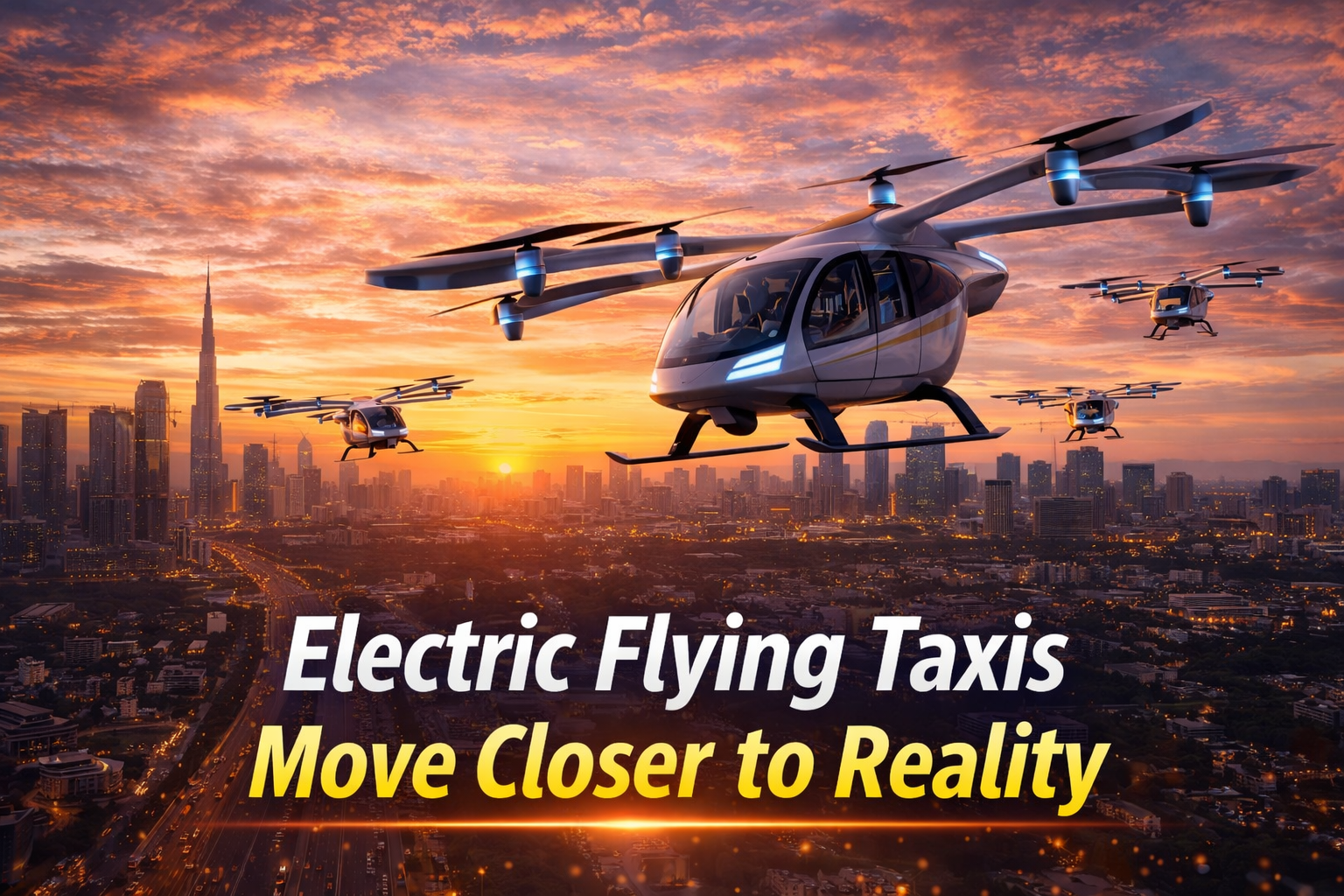
Electric Flying Taxis Move Closer to Reality as Major Cities Prepare for Air Taxi Travel
The future of transportation is changing rapidly, and Electric Flying Taxis Move Closer to Reality as companies and governments work together to introduce air taxi services in major cities. These futuristic aircraft, often known as electric vertical take-off and landing vehicles (eVTOL), could soon transform the way people travel in crowded urban areas.
With rising traffic congestion and increasing demand for faster transportation, electric flying taxis are being developed as a solution that could make commuting quicker, cleaner, and more efficient.
What Are Electric Flying Taxis?
Electric flying taxis are small aircraft powered by electricity instead of traditional aviation fuel. They are designed to take off and land vertically, much like helicopters, but they are quieter and produce fewer emissions.
Because of this innovative design, electric flying taxis can operate from small landing areas called “vertiports,” which can be built on rooftops or near major transportation hubs.
The idea behind this technology is simple: instead of traveling through traffic-filled roads, passengers can fly above the city and reach their destinations in minutes.
Companies Leading the Air Taxi Revolution
Several technology and aviation companies are investing heavily in this new industry as Electric Flying Taxis Move Closer to Reality.
One of the leading developers is Joby Aviation, which has been testing fully electric aircraft capable of carrying passengers over urban distances.
Another company pushing forward with this innovation is Archer Aviation, which plans to launch commercial air taxi services in selected cities in the coming years.
Meanwhile, European developer Volocopter has already conducted multiple test flights and is working closely with regulators to make urban air mobility a reality.
These companies believe electric flying taxis could eventually become a common mode of transport in large cities.
Major Cities Preparing for Air Taxi Services
As Electric Flying Taxis Move Closer to Reality, several cities around the world are preparing the infrastructure needed for these services.
Cities like Los Angeles, Dubai, and Paris have already announced plans to develop vertiports and air mobility networks.
In Dubai, authorities are actively testing flying taxi systems as part of their vision to create one of the most advanced transportation networks in the world.
Meanwhile, Paris has been exploring the use of air taxis during major international events and urban mobility projects.
These developments show that the concept of air taxis is moving from science fiction to real-world implementation.
Benefits of Electric Flying Taxis
There are several reasons why electric flying taxis are gaining global attention as Electric Flying Taxis Move Closer to Reality.
Faster Urban Travel
Flying taxis could significantly reduce travel time. A journey that takes an hour by car during rush hour could take just 10 to 15 minutes in the air.
Reduced Traffic Congestion
Urban areas around the world struggle with heavy traffic. Air taxis could move a portion of commuters into the sky, easing pressure on roads.
Lower Carbon Emissions
Because these aircraft use electric power, they produce fewer emissions compared to traditional helicopters and cars.
Future Smart Cities
Electric flying taxis could become an important part of smart city transportation systems alongside electric vehicles, high-speed trains, and autonomous cars.
Challenges Before Full Launch
Although Electric Flying Taxis Move Closer to Reality, there are still several challenges that must be addressed before they become widely available.
Regulatory approvals, safety certifications, and air traffic management systems need to be developed to ensure safe operations in crowded city airspace.
Infrastructure is another challenge. Cities must build vertiports, charging stations, and dedicated flight routes for air taxis.
Cost is also a factor. Early air taxi rides may be expensive, but experts believe prices will decrease as the technology becomes more common.
The Future of Urban Air Mobility
Despite these challenges, the progress made in recent years shows that Electric Flying Taxis Move Closer to Reality faster than many people expected.
Industry experts predict that commercial air taxi services could begin operating in select cities within the next few years. As technology improves and regulations evolve, flying taxis could become a normal part of urban transportation.
If successful, this innovation could redefine city travel and open the door to a completely new era of mobility.
For millions of commuters around the world, the idea of flying above traffic may soon become a daily reality rather than a futuristic dream.