

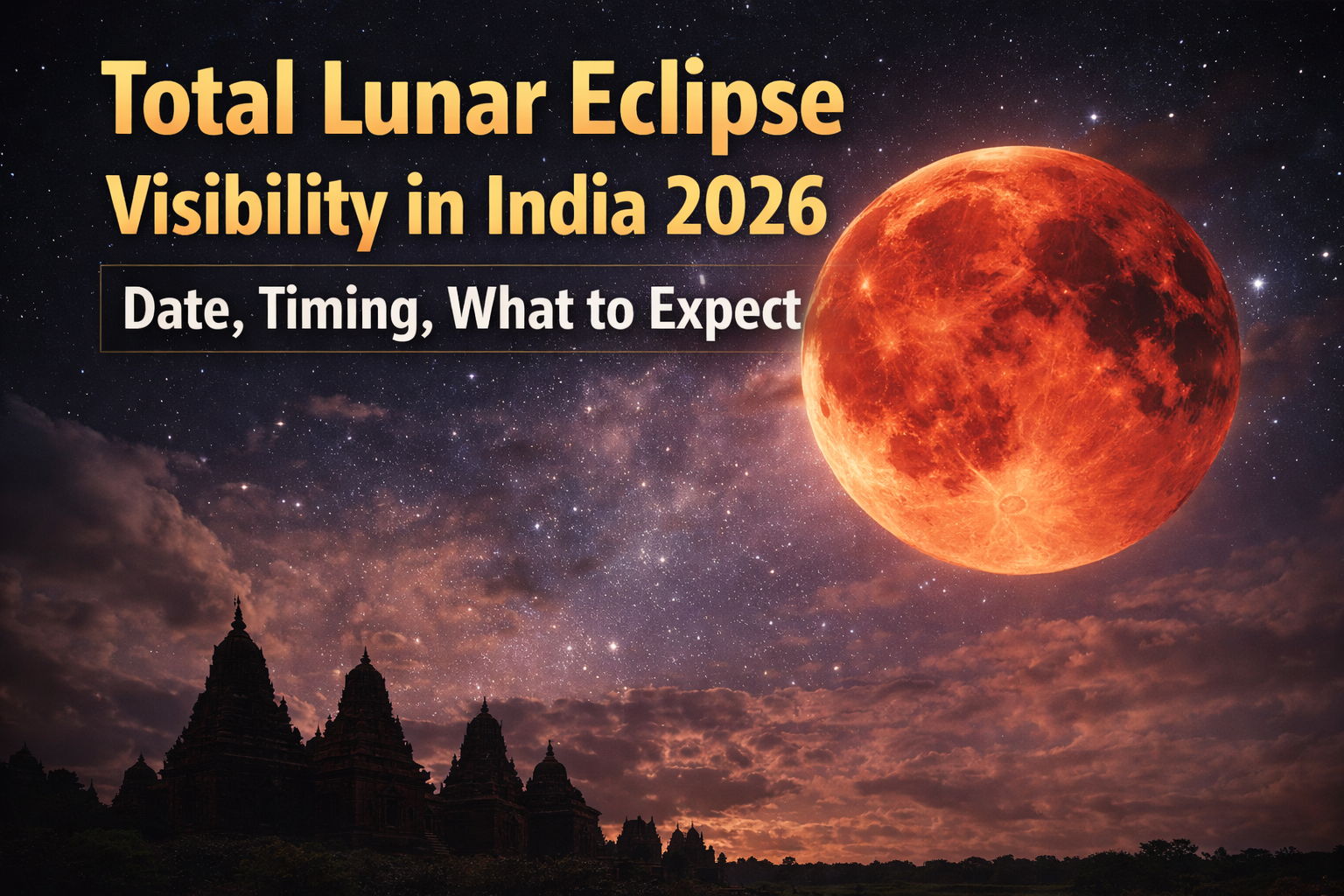
Total Lunar Eclipse Visibility in India 2026: Exact Date, Timing, What to Expect
A rare and mesmerizing astronomical event is set to captivate skywatchers across India and around the world — the Total Lunar Eclipse Visibility in India 2026 on March 3, 2026. Known as a “Chandra Grahan” in India, this eclipse will turn the full moon into a glowing copper-red orb for observers across many regions of the country.
Because it coincides with popular celebrations like Holi, millions of viewers and astronomy enthusiasts are already preparing to witness this spectacular celestial phenomenon.
What Is a Total Lunar Eclipse?
A total lunar eclipse occurs when the Sun, Earth, and Moon align so that Earth’s shadow completely covers the surface of the Moon. Unlike a solar eclipse that requires protective eyewear, a lunar eclipse is safe to observe directly with the naked eye.
During the total phase, the Moon takes on a reddish hue — a result of sunlight bending through Earth’s atmosphere, known as “Rayleigh scattering.” This gives the Moon its characteristic “blood moon” appearance.
When Is the Total Lunar Eclipse in India 2026?
The Total Lunar Eclipse Visibility in India 2026 will occur on March 3, 2026, and is expected to be one of the most watched eclipses of the decade.
According to officials from the India Meteorological Department (IMD), this lunar eclipse will be visible in many parts of India, weather permitting, from late evening into the early hours of the next day.
Exact viewing times vary by location, but most regions will see the progression of the eclipse starting after moonrise, which means observers in northern and central India will have the best chance to catch the full sequence.
How to Watch the Total Lunar Eclipse
Observing the Total Lunar Eclipse Visibility in India 2026 is easier than it sounds — here’s how to prepare:
📍 Best Viewing Spots
- Open sky areas away from tall buildings
- Less light-polluted regions
- Rooftops and open fields
🕒 What To Look For
- Penumbral Phase — Moon enters Earth’s outer shadow
- Partial Phase — Darkening begins
- Total Phase — Moon glows red
Because this eclipse occurs on the night of March 3, make sure to check local moonrise times so you don’t miss the peak totality.
Why This Eclipse Matters
The Total Lunar Eclipse Visibility in India 2026 isn’t just another astronomical event — it’s significant for cultural, educational, and scientific reasons.
⭐ Cultural Importance
In India, celestial events like lunar eclipses are woven into mythology and festival celebrations. With Holi celebrated around the same time, communities will mark the eclipse while also participating in cultural festivities.
🧑🔬 Educational Value
Schools, astronomy clubs, universities, and science organisations across India are planning viewing events and public awareness programs to help people learn about lunar phenomena and the universe.
Tips for Photographing the Eclipse
Millions of enthusiasts plan to photograph this eclipse using:
- DSLR cameras with telephoto lenses
- Smartphone cameras with clip-on telescopes
- Tripods for stable shots
For beginners, even a smartphone held steady can capture stunning images of the red moon, especially during totality when the lunar surface takes on dramatic color contrasts.
Safety and Misconceptions
Unlike solar eclipses, lunar eclipses do not harm your eyes if watched directly. However, some traditional beliefs still recommend staying indoors — science organisations across India have clarified that viewing is harmless and educational.
Final Thoughts
The Total Lunar Eclipse Visibility in India 2026 promises to be an unforgettable celestial experience — one that unites science, culture, and curiosity under one sky.
Whether you watch from your rooftop, a local park, or a community telescope event, this event offers a moment of wonder that millions will be talking about for years.
Skywatchers everywhere are already marking their calendars and sharing viewing tips on social media, making this one of the most anticipated astronomical events of the year.