

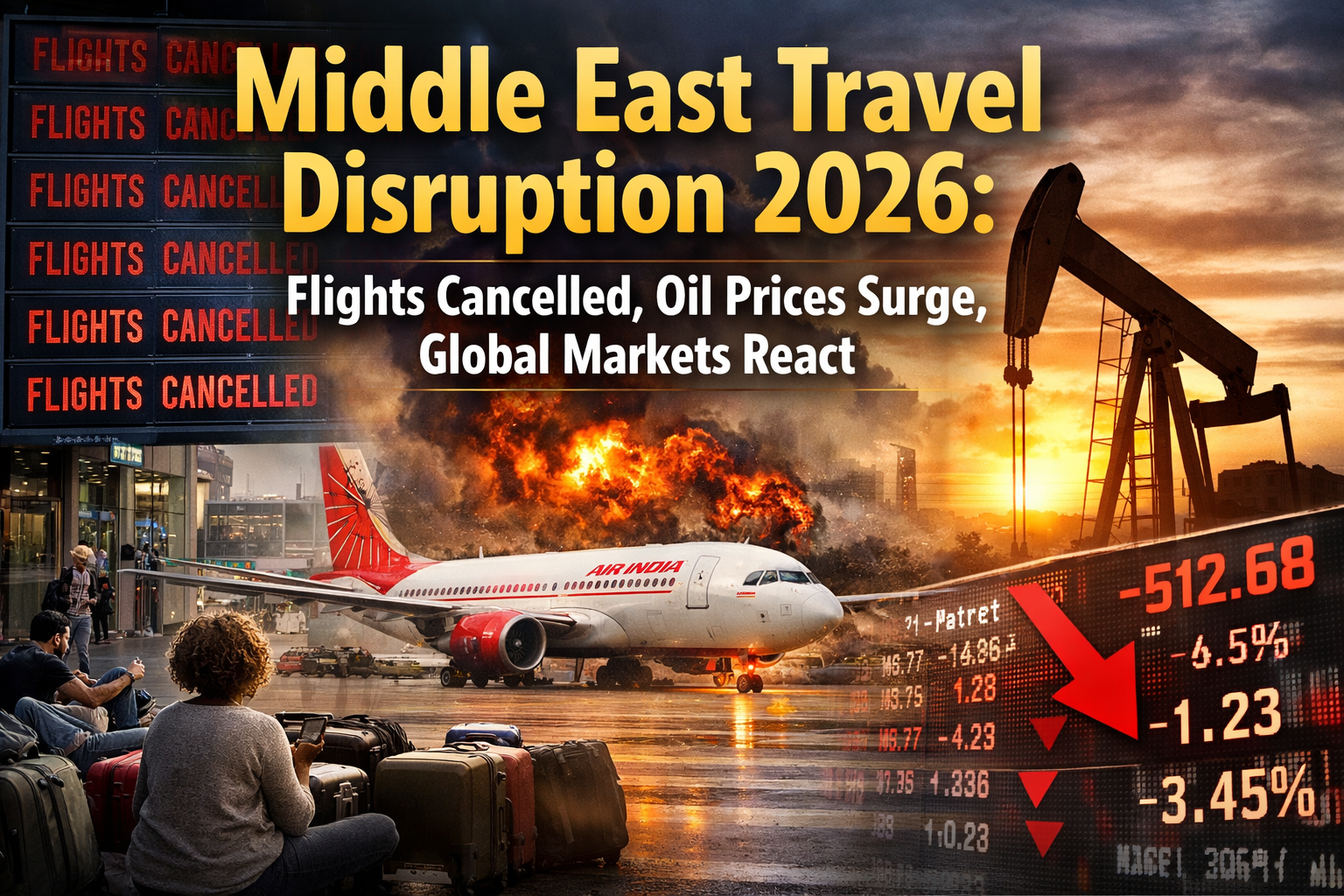
📰 Middle East Travel Disruption 2026: Flights Cancelled, Oil Prices Surge, Markets React Globally
The Middle East Travel Disruption 2026 has rapidly become one of the biggest global breaking news stories, affecting millions of passengers, global airlines, oil markets, and even Indian students abroad. What began as escalating geopolitical tensions has now turned into a major aviation and economic crisis impacting countries across Asia, Europe, and the Gulf region.
As airlines suspend operations and oil prices rise sharply, experts warn that the Middle East Travel Disruption 2026 could have long-term consequences for international travel and global markets.
✈️ Massive Flight Cancellations Across Key Routes
The Middle East Travel Disruption 2026 has forced several major airlines to cancel or reroute flights due to safety concerns in sensitive airspace corridors.
Airlines including IndiGo, Air India, Emirates, Qatar Airways, and Air France-KLM have suspended multiple services connecting India with Gulf countries and parts of Europe. Thousands of passengers are stranded or facing last-minute cancellations.
Flights between India and destinations such as:
- United Arab Emirates
- Saudi Arabia
- Qatar
- Kuwait
- Oman
- Israel
have either been cancelled or delayed.
Travel agencies report a surge in refund requests, rescheduling, and emergency bookings via alternative routes. Aviation experts say this is one of the largest coordinated airspace disruptions in recent years.
🇮🇳 Impact on Indian Passengers and Students
India is feeling the direct impact of the Middle East Travel Disruption 2026.
Many Indian professionals working in Gulf nations are struggling to return home or travel back to their workplaces. Families planning vacations are cancelling trips due to uncertainty.
In addition, Indian students in Middle Eastern countries are facing academic uncertainty. Some examination schedules have reportedly been affected due to safety concerns and travel limitations.
The situation has created anxiety among parents and students, especially those preparing for board-level examinations.
🛢 Oil Prices Surge Amid Crisis
One of the biggest economic consequences of the Middle East Travel Disruption 2026 is the sudden spike in oil prices.
The Middle East is home to some of the world’s largest oil-producing nations. Any instability in the region directly affects global energy supply chains.
With concerns about possible supply interruptions through critical shipping routes, oil prices have surged in international markets. This could potentially lead to:
- Higher petrol and diesel prices
- Increased transportation costs
- Rise in inflation
- Increased cost of goods and services
Economic analysts warn that if the Middle East Travel Disruption 2026 continues for several weeks, consumers worldwide may feel the financial impact.
📉 Stock Markets React to Uncertainty
Global financial markets have shown signs of volatility following the Middle East Travel Disruption 2026.
Airline stocks and travel-related companies experienced noticeable declines due to operational uncertainty. Meanwhile, energy stocks witnessed fluctuations linked to oil price movements.
Indian stock markets also reacted cautiously, with investors closely monitoring geopolitical developments. Market experts suggest that geopolitical instability often creates short-term volatility but may stabilize once diplomatic clarity emerges.
🌍 Diplomatic Efforts Underway
As the Middle East Travel Disruption 2026 unfolds, global leaders are engaging in diplomatic discussions to prevent further escalation.
International organizations and world governments are urging restraint and dialogue to ensure regional stability. Aviation authorities are closely coordinating with defense and security agencies to monitor safe airspace corridors.
Diplomacy remains the key factor that could either ease or intensify the ongoing travel disruption.
🧳 What Travelers Should Do Now
If you have upcoming travel plans involving Middle Eastern destinations, experts advise:
- Regularly check airline announcements
- Monitor official airport updates
- Avoid non-essential travel to sensitive zones
- Keep alternative travel plans ready
- Stay informed through verified government advisories
Passengers are also advised to avoid relying on social media rumors and instead follow official airline communication channels.
📊 How Long Could This Last?
Aviation analysts say the duration of the Middle East Travel Disruption 2026 depends largely on diplomatic developments and regional stability.
If tensions ease quickly, flight operations could gradually resume within days or weeks. However, prolonged instability could lead to extended travel restrictions and economic ripple effects.
🧠 Why This Story Matters Globally
The Middle East Travel Disruption 2026 is not just a regional issue — it is a global event affecting travel, economy, education, oil markets, and international relations.
For India especially, with millions of citizens living and working in Gulf nations, the situation carries both emotional and economic importance.
As developments continue, this remains one of the most closely watched breaking news stories worldwide.