

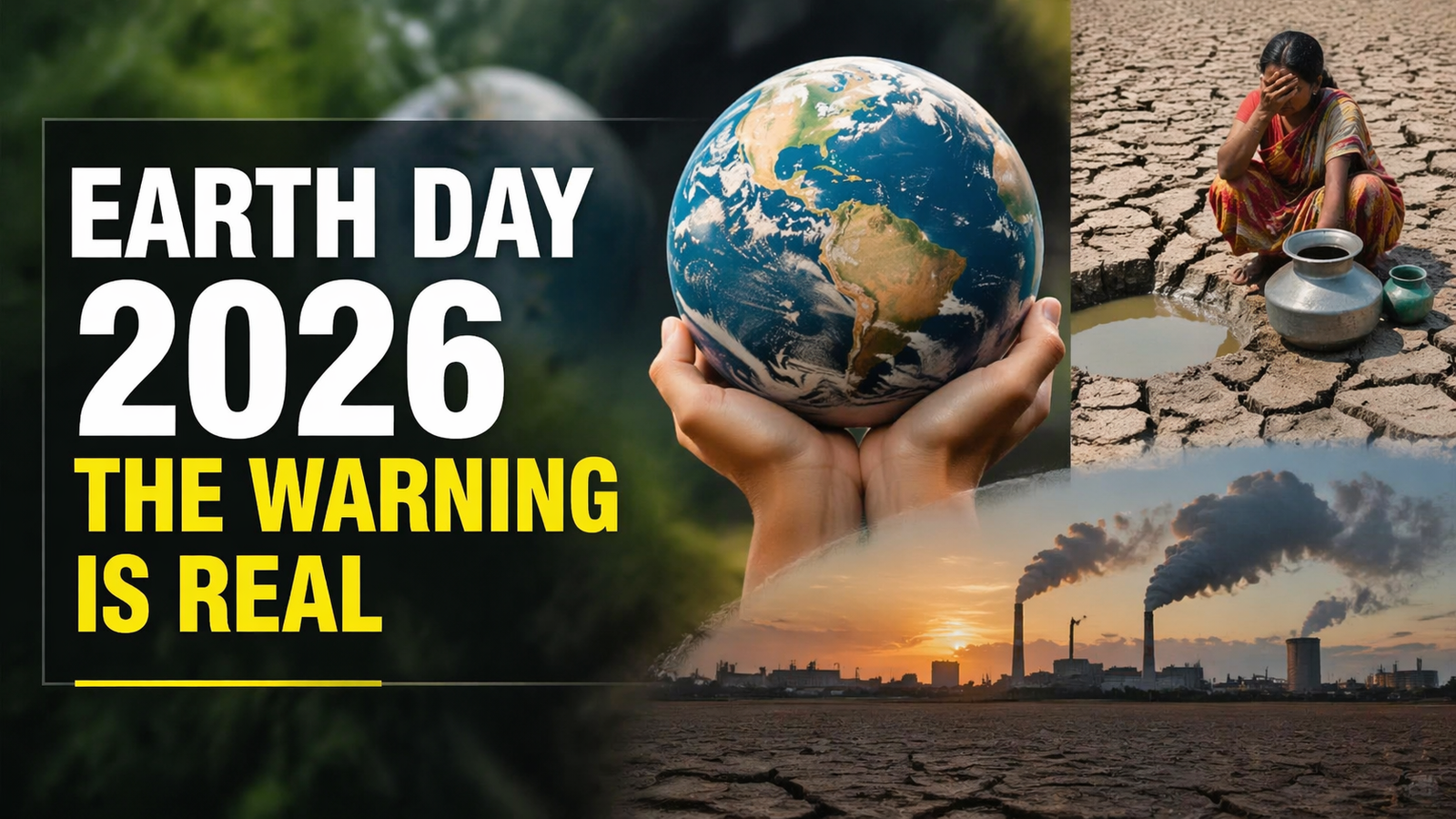
🌍 A Different Kind of Earth Day… Something Feels Off
Every year, Earth Day comes with the usual mix of tree-planting drives, social media posts, and hopeful messages about saving the planet. But this time… it feels different.
There’s a quiet shift in tone. Less celebration, more concern.
Honestly, if you scroll through the news or even your social feeds right now, you’ll notice it too. The conversations aren’t just about “protecting nature” anymore—they’re about what happens if we don’t act fast enough.
And that’s what makes Earth Day 2026 stand out. It doesn’t feel symbolic. It feels… urgent.
🌡️ What’s Actually Happening This Year?
Let’s break it down simply.
Across the world, scientists and environmental groups are raising stronger warnings than ever before. Rising temperatures, unpredictable weather patterns, and water shortages aren’t distant problems anymore—they’re happening in real time.
In fact, recent global initiatives are now focusing on something that wasn’t talked about enough before: water access. Experts estimate that over 1 billion people could face serious water shortages in the coming years if conditions continue like this.
That’s not a far-off statistic. That’s a real, growing issue.
And surprisingly, this shift—from general climate talk to specific crises like water—has made this year’s Earth Day messaging much sharper.
⏳ Why This Moment Actually Matters
Here’s the thing: climate conversations have been happening for decades. But most of the time, they felt distant—like something future generations would deal with.
That illusion is breaking.
This year, the warnings are tied to timelines, not just theories. Scientists are no longer saying “this could happen someday.” They’re saying:
“Wait… Robots Just Beat Humans in a Marathon?” — The Internet Is Lowkey Freaking Out
- Some regions are already running out of groundwater
- Heatwaves are becoming more frequent and intense
- Weather patterns are getting harder to predict
And that changes everything.
Because once a problem becomes immediate, people start paying attention differently.
🧠 Let’s Be Real — How This Affects You
It’s easy to think climate change is a “global issue” that doesn’t directly touch your daily life. But if you look closely, it already does.
Take India, for example.
- Summers are getting hotter, earlier
- Water shortages are becoming common in cities
- Food prices fluctuate due to unpredictable weather
These aren’t abstract problems. They affect how you live, what you pay, and even your health.
And truth is, this is exactly why Earth Day 2026 is gaining traction on platforms like Google Discover. It’s not just awareness—it’s relevance.
People aren’t just reading about the planet anymore. They’re reading about their own future.
💧 The Water Crisis No One Can Ignore
If there’s one issue dominating this year’s conversation, it’s water.
Not pollution. Not just carbon emissions. But access to clean, usable water.
And it makes sense when you think about it.
Water is everything—drinking, farming, daily life. When that starts becoming uncertain, everything else follows.
Global organizations have already started rolling out large-scale programs aimed at improving water access. But even those efforts come with a warning: solutions need to scale fast.
Because demand is rising… and supply isn’t keeping up.
🌦️ Climate Is Getting Less Predictable (And That’s a Problem)
Another thing that stands out this year is how unpredictable weather has become.
It’s not just about “hotter summers” anymore.
It’s about:
- Sudden storms in places that rarely see them
- Delayed or weaker monsoons
- Extreme heat followed by unexpected rainfall
And here’s why that matters.
When weather becomes unpredictable, planning becomes difficult. Farmers struggle. Cities aren’t prepared. Infrastructure gets tested.
In simple terms, uncertainty becomes the real problem.
📈 Why This Is Trending Right Now
You might be wondering—why is this topic suddenly everywhere?
It comes down to three things:
- Timing – Earth Day naturally brings global attention
- Relevance – People are experiencing these changes firsthand
- Emotion – There’s a mix of concern, curiosity, and urgency
Google Discover tends to push content that feels both important and personal. And this topic hits that balance perfectly.
It’s not just news—it’s something people feel connected to.
🔮 What Could Happen Next?
Looking ahead, a few things seem likely.
First, climate-related discussions will become more specific. Instead of broad topics, we’ll see focus areas like water, agriculture, and urban planning.
Second, governments and organizations may start taking more visible action—not just policies, but actual on-ground changes.
And third, public awareness will continue to grow. Slowly, but steadily.
Because once people start noticing changes in their own lives, it’s hard to ignore.
what happens if we don’t act fast enough.
And maybe that’s the part that’s making people pause this year.
It’s not loud panic. It’s something subtler—like a growing realization that the window to fix things isn’t as wide as we once thought. You see it in small ways: longer summers, water tankers becoming normal in some areas, farmers talking about unpredictable seasons. These aren’t headlines anymore—they’re everyday conversations.
What’s interesting, though, is that alongside all this concern, there’s also a shift in awareness. People are asking better questions. Not just “what’s happening?” but “what can actually be done?” And that change in mindset matters.
Because Earth Day 2026 isn’t just about raising awareness—it’s quietly pushing people toward responsibility. Not in a dramatic, overwhelming way, but in a steady, almost unavoidable way.
And truth is, that might be exactly what this moment needs.
🤔 FAQ
1. Why is Earth Day 2026 getting so much attention?
This year feels more urgent because climate issues are no longer distant. People are experiencing real effects like heatwaves and water shortages.
2. What is the biggest concern right now?
One of the biggest concerns is water scarcity, with over a billion people potentially at risk in the near future.
3. Is climate change really affecting daily life?
Yes. From rising temperatures to food prices and water availability, the impact is becoming more visible.
4. What can individuals actually do?
Small actions like conserving water, reducing waste, and being mindful of energy use can collectively make a difference.
5. Will things get worse?
If action is delayed, conditions may worsen. However, with strong global efforts, some impacts can still be managed.
🌱 Final Thoughts — This One Feels Different
Earth Day has always been about awareness.
But this year… it feels more like a checkpoint.
A moment where the conversation shifts from “we should act” to “we need to act now.”
And maybe that’s not a bad thing.
Because sometimes, it takes a little discomfort to create real change.
The question is—what happens after today?