

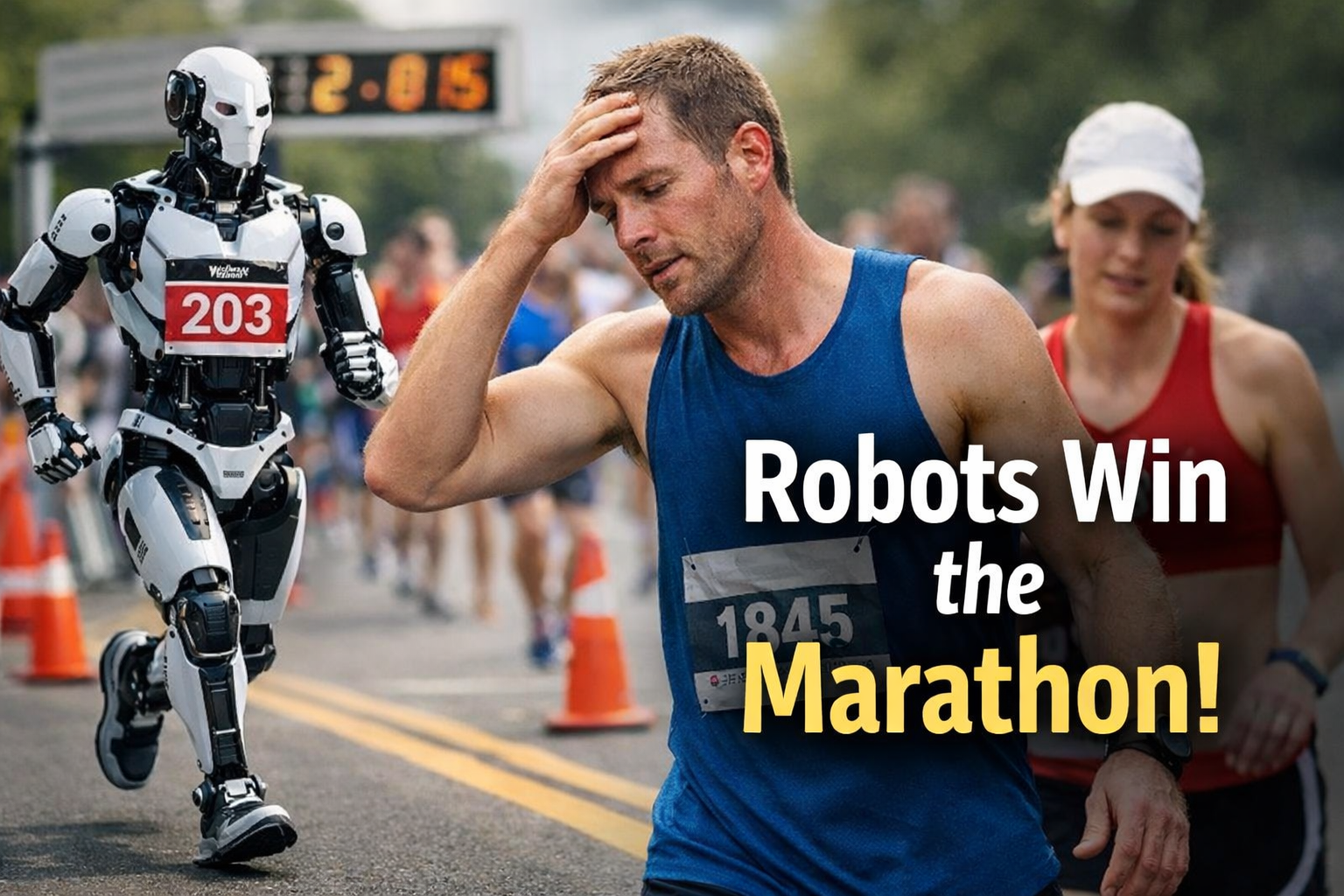
Okay… this sounds fake at first.
Like something straight out of a movie.
But it’s real.
A group of humanoid robots actually ran a half marathon in Beijing—and yeah… some of them didn’t just survive it… they performed better than humans.
And now people online are asking one thing:
“If robots can do THIS… what can’t they do?”
🤖 What Actually Happened?
So here’s the situation.
At a recent marathon event in Beijing, multiple robotics companies brought their human-like robots to participate in a real race alongside people.
AI Security Scare? What OpenAI Just Revealed Has People Asking One Big Question…
Not a lab test.
Not a simulation.
A real outdoor run.
These robots:
- Ran on two legs (like humans)
- Maintained balance on roads
- Adjusted speed mid-race
- Didn’t collapse after 5 minutes like older models used to
And the wild part?
👉 Some of them lasted longer and performed more consistently than average runners.
Not necessarily Olympic-level speed… but endurance + stability?
That’s where things got interesting.
😳 Why This Is Kind of a Big Deal
Let’s be honest.
We’ve all seen robots before.
Factories, vacuum cleaners, delivery bots… nothing new.
But this?
This hits different.
Because running is human.
It requires:
- Balance
- Coordination
- Real-time decision making
- Physical endurance
And robots just showed they can do all of that… together.
That’s not just “tech progress.”
That’s a shift.
🧠 The Bigger Picture (This Is Where It Gets Serious)
A lot of people are focusing on the “cool” part.
But the real story is deeper.
If robots can:
- Run
- Adapt to terrain
- Maintain energy efficiency
Then tomorrow they could:
- Work physical jobs
- Assist in rescue missions
- Replace repetitive labor
- Even enter sports or competitions
And yeah… that raises some uncomfortable questions.
👉 Where do humans stand when machines start catching up physically AND mentally?
📉 Are Humans Being Replaced? (Let’s Not Panic… Yet)
Short answer: No. Not yet.
Long answer:
These robots are still:
- Expensive
- Controlled/monitored
- Not fully independent in decision-making
They’re not about to show up at your gym and take your treadmill 😅
But…
The speed of progress?
That’s what’s shocking people.
Because just a few years ago, robots could barely walk properly.
Now they’re running marathons.
🔍 Real-World Use Cases (Not Just Hype)
This isn’t just for headlines.
There are actual practical uses already being discussed:
🚑 Disaster Response
Robots that can run could reach areas humans can’t during earthquakes or fires.
📦 Delivery & Logistics
Imagine robots that don’t just roll—but actually run packages across cities.
🏭 Physical Labor
Jobs that require stamina could slowly shift toward automation.
🌍 What Governments & Companies Are Doing
Countries like China, the US, and Japan are heavily investing in robotics right now.
Tech companies are racing to build:
- Faster humanoid robots
- More energy-efficient systems
- Better AI decision-making
This marathon wasn’t random.
It was a public showcase of progress.
Basically saying:
👉 “Look how far we’ve come.”
💬 Internet Reaction (This Part Is Wild)
Online reactions are split.
Some people are like:
“This is insane. The future is here.”
Others are more like:
“Yeah… this is how every sci-fi movie starts.”
And honestly?
Both sides kind of make sense.
🏃♂️ The Part Nobody’s Talking About (Energy, Not Speed)
Everyone’s stuck on one thing—
“Did robots beat humans?”
But honestly… that’s not even the most interesting part.
The real story?
👉 Energy efficiency.
Humans get tired.
We slow down.
We need water, rest, recovery.
These robots?
They don’t “feel” tired. They just manage power.
And what shocked researchers is how efficiently some of these robots used their energy across long distances. They didn’t sprint and crash. They maintained a steady pace—almost like they were programmed to run smart, not fast.
That’s something even experienced runners struggle with.
And if that efficiency keeps improving…
we’re not just talking about robots running.
We’re talking about robots that can outlast humans in physically demanding situations.
🔋 Wait… What Happens When Battery Tech Improves?
Right now, robots are still limited by one big thing:
👉 Battery life
But imagine this:
- Longer-lasting batteries
- Faster charging
- Lightweight power systems
Suddenly, that one limitation disappears.
10 AI Tools to Make Money Online in 2026 (Beginner to Pro Guide That Actually Works)
And when that happens?
These robots won’t just run a marathon…
they could work for hours without stopping.
No breaks.
No burnout.
No fatigue.
That’s where industries start paying serious attention.
Because from a business perspective…
that’s not innovation.
That’s replacement potential.
🧠 The Psychology Shift (Why This Feels Weird)
Let’s be real for a second.
This news feels uncomfortable.
Not because robots are dangerous…
but because they’re entering a space we thought was ours.
Running isn’t just movement.
It’s:
- Discipline
- Effort
- Pain tolerance
- Mental strength
And now machines are stepping into that space like:
“Yeah, we can do that too.”
That hits differently.
It’s almost like watching something human being copied.
And people aren’t fully sure how to react to that yet.
📲 Social Media Is Turning This Into a Bigger Story
This is where things really explode.
Clips of robots running are already spreading fast.
And you know how the internet works:
- One viral video → millions of views
- People add dramatic music
- Someone compares it to a sci-fi movie
- Suddenly it becomes a trend, not just news
Now it’s not just:
“Robots ran a marathon”
It becomes:
👉 “The beginning of human replacement”
Even if that’s exaggerated…
it drives insane engagement.
And platforms like Instagram, YouTube Shorts, and TikTok?
They love this kind of content.
⚠️ The Line Between Cool and Concerning
Here’s where things get a bit… complicated.
On one side:
- This is amazing progress
- Could save lives
- Could improve industries
On the other:
- Job concerns
- Over-dependence on machines
- Ethical questions
Like… should robots even compete with humans in physical challenges?
Or should there be limits?
Right now, there aren’t clear answers.
And that uncertainty?
That’s exactly what makes this story so powerful.
🔮 Imagine This 5 Years From Now
Let’s fast forward a bit.
Picture this:
- Robots running alongside humans in public events
- Fitness apps tracking robot vs human performance
- Companies sponsoring robot athletes
- Entire leagues just for humanoid competitions
Sounds crazy?
Yeah… but so did robots running marathons a few years ago.
🧩 One Small Event… Big Signal
This marathon might look like a small experiment.
But it’s actually a signal.
A signal that:
- Robotics is moving out of labs
- Machines are entering real-world environments
- The gap between human and machine ability is shrinking
And once that gap starts closing…
It usually doesn’t stop.
❓ FAQ (People Are Already Asking)
1. Did robots actually beat professional runners?
Not elite athletes—but they performed better than average participants in terms of consistency.
2. Are robots faster than humans now?
Not yet overall—but they’re catching up in endurance and stability.
3. Is this dangerous?
Not immediately, but it shows how fast robotics is evolving.
4. Can robots replace athletes?
Highly unlikely right now—but the conversation has started.
🧩 What Happens Next?
This is probably just the beginning.
Next we might see:
- Robots in sports demonstrations
- Faster, more agile humanoids
- Integration with AI for real-time decisions
And eventually…
The line between human ability and machine ability might get blurry.
🧠 Final Thoughts
A few years ago, this would sound ridiculous.
Now it’s just… news.
And that’s the scary part.
Not that robots are running—
but how quickly we’re getting used to it.
🔗 Sources (placed naturally for credibility)
- Reuters Tech Coverage
- Global robotics event reports
- Industry AI development updates